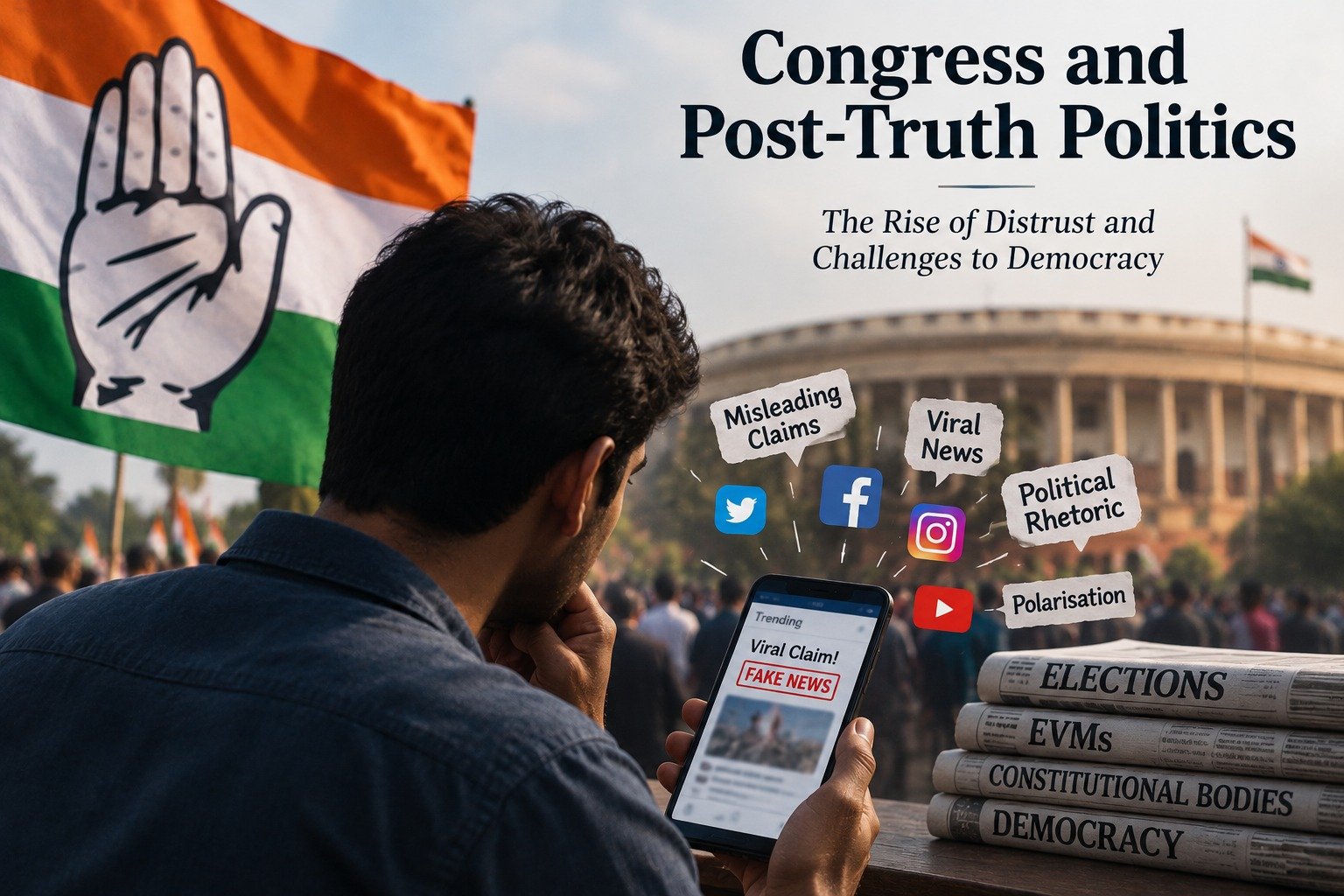
Post-truth politics has emerged as a key issue in contemporary democracies, where feelings, political discourse, and personal opinions sometimes outweigh factual information. Political parties, such as the Indian National Congress in India, have frequently been accused of spreading misleading information through their rhetoric, political campaigns, and communication.
The concept of ” political campaigns” is associated with the situation in which emotional rhetoric and reiteration of claims impact the perceptions of the public audience regardless of whether factual information reveals another picture. The development of social media has added a new dimension to this problem, as political rhetoric, allegations and opinions can easily circulate through social media networks.
When it comes to political parties, communication is an important tool for informing people. In this respect, the Congress is similar to other major political parties since it uses speeches, press releases, election campaigns, and digital media to communicate its views and challenge the policy of its rivals. Still, the political statements, which may be challenged by a lack of evidence, can cause misunderstanding between people.
The most problematic issue is that institutions are often challenged without providing any evidence or giving opportunities for verification of allegations. For instance, issues with elections, electronic voting machines and the Election Commission might affect people’s attitude towards political processes. Still, the criticism of constitutional bodies should be an acceptable practice within democracy, provided there is evidence and appropriate channels for challenging them.
Moreover, social media makes the problem worse in that misleading news may spread like wildfire before any fact-finding or journalistic effort is made to verify it. The result is greater political polarisation, a lack of constructive debate, and an added difficulty for citizens to distinguish facts from partisanship. There is even a research paper written about misinformation and its effect on the Indian general election of 2024.
Responsibility is required from all political parties, including the Congress, to strengthen democracy in India. It is incumbent upon politicians to back their accusations with proof and acknowledge when they make mistakes or give out false information. Journalists, a fair election system and educated citizens are no less necessary for this purpose.
In conclusion, democracy is not only based on elections, but on public confidence and accountability, and accurate information as well. There will always be political disputes between different parties, but they need to be sorted out via facts and discussion rather than unconfirmed statements.



Congress and Post-Truth Politics: The Rise of Distrust and Challenges to Democracy
Post-truth politics has emerged as a key issue in contemporary democracies, where feelings, political discourse, and personal opinions sometimes outweigh factual information. Political parties, such as the Indian National Congress in India, have frequently been accused of spreading misleading information through their rhetoric, political campaigns, and communication.The concept of ” political campaigns” is associated with…

by
No comments on Congress and Post-Truth Politics: The Rise of Distrust and Challenges to Democracy
2 minutes
Read Time
About the Author

Previous Post
Next Post
Leave a Reply
Latest News






About the Author

thefirstcritic
The First Critic delivers the latest news and sharp insights across India, politics, business, entertainment, sports, technology, and more.
Search the Archives
Access over the years of investigative journalism and breaking reports