






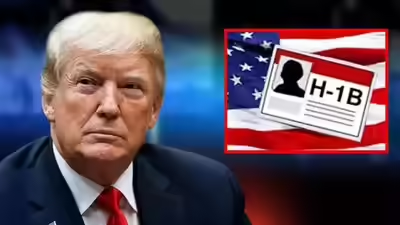
Recently, the White House caused a stir when it announced a $100,000 fee for H-1B visa applications. The initial number may seem shocking. However, there is a much more nuanced reality, especially for F-1 international students.
1. The Fee Is Not What It Appears
The $100,000 charge is not something that students themselves pay in advance. The fee is only relevant to new H-1B applications submitted by employers for foreign nationals in the U.S. Filing an H-1B renewal, transfer, or applying as a current H-1B holder in and of itself does not affect the fee. Although this detail may seem trivial, it is an important distinction: in terms of practical matters, an F-1 visa student’s fees will not be the direct provocation of this expense of $100,000.
The fee functions more as a filter for employers than a tax on talent. It’s designed to deter companies from replacing U.S. workers with cheaper foreign labor, not to punish students striving for a career in America.
2. A Potential Shift in Employer Behavior
While students aren’t paying, employers may hesitate to sponsor H-1B petitions, especially for entry-level positions with lower salaries. This creates a hidden consequence: the “cost of talent” may shift the focus from international innovation to domestic hiring.
Uncommon perspective: Students might need to consider not just eligibility but strategic timing and choice of employer, prioritizing firms that can absorb the fee or see long-term value in sponsoring foreign talent.
3. The Global Talent Angle
India, one of the largest suppliers of STEM talent to the U.S., has raised alarms. Industry organizations like Nasscom claim that only new applicants will be impacted, but the trickle-down effect could still be significant. Some Indian professionals may seek to return home or go to other countries with less restrictive immigration policies.
Insight: This fee may fuel a growing trend of “brain circulation,” where skilled workers circulate between countries rather than settling only in the U.S., which could ultimately enhance the innovation ecosystem in other parts of the world.
4. Why This Matters Beyond Money
At first glance, $100,000 appears to represent a barrier. More fundamentally, the discussion is about valuing talent and the competition for talent across the world. Countries across the globe are in a race to attract talent, and policy like this one reflects a precarious balance between the desire to protect domestic jobs and the desire to remain a magnet for global talent.
Uncommon takeaway: Students should see the fee not as a personal limitation, but as evidence of shifting employer strategies and global opportunity landscapes.
Useful Tips for Students.
The Hidden Truth Behind the $100K H-1B Fee for F-1 Students
Recently, the White House caused a stir when it announced a $100,000 fee for H-1B visa applications. The initial number may seem shocking. However, there is a much more nuanced reality, especially for F-1 international students.
1. The Fee Is Not What It Appears
The $100,000 charge is not something that students themselves pay in advance. The fee is only relevant to new H-1B applications submitted by employers for foreign nationals in the U.S. Filing an H-1B renewal, transfer, or applying as a current H-1B holder in and of itself does not affect the fee. Although this detail may seem trivial, it is an important distinction: in terms of practical matters, an F-1 visa student’s fees will not be the direct provocation of this expense of $100,000.
The fee functions more as a filter for employers than a tax on talent. It’s designed to deter companies from replacing U.S. workers with cheaper foreign labor, not to punish students striving for a career in America.
2. A Potential Shift in Employer Behavior
While students aren’t paying, employers may hesitate to sponsor H-1B petitions, especially for entry-level positions with lower salaries. This creates a hidden consequence: the “cost of talent” may shift the focus from international innovation to domestic hiring.
Uncommon perspective: Students might need to consider not just eligibility but strategic timing and choice of employer, prioritizing firms that can absorb the fee or see long-term value in sponsoring foreign talent.
3. The Global Talent Angle
India, one of the largest suppliers of STEM talent to the U.S., has raised alarms. Industry organizations like Nasscom claim that only new applicants will be impacted, but the trickle-down effect could still be significant. Some Indian professionals may seek to return home or go to other countries with less restrictive immigration policies.
Insight: This fee may fuel a growing trend of “brain circulation,” where skilled workers circulate between countries rather than settling only in the U.S., which could ultimately enhance the innovation ecosystem in other parts of the world.
4. Why This Matters Beyond Money
At first glance, $100,000 appears to represent a barrier. More fundamentally, the discussion is about valuing talent and the competition for talent across the world. Countries across the globe are in a race to attract talent, and policy like this one reflects a precarious balance between the desire to protect domestic jobs and the desire to remain a magnet for global talent.
Uncommon takeaway: Students should see the fee not as a personal limitation, but as evidence of shifting employer strategies and global opportunity landscapes.
Useful Tips for Students.
You shouldn’t stress about the cost—it’s not your problem.
Be thorough about the employers you choose, who are willing and able to sponsor your H-1B. Look internationally—opportunities outside the U.S. could look better. Keep yourself in the know—be on the lookout for USCIS alerts and university announcements.






More Stories
Elon Musk is the world’s richest person with $850 billion in wealth, but how much cash does he have? He reveals
The 2026 wanderlist: Five cities that reveal their secrets on foot
US says Mexican drug cartel drones breached airspace, triggered temporary closure at El Paso airport