






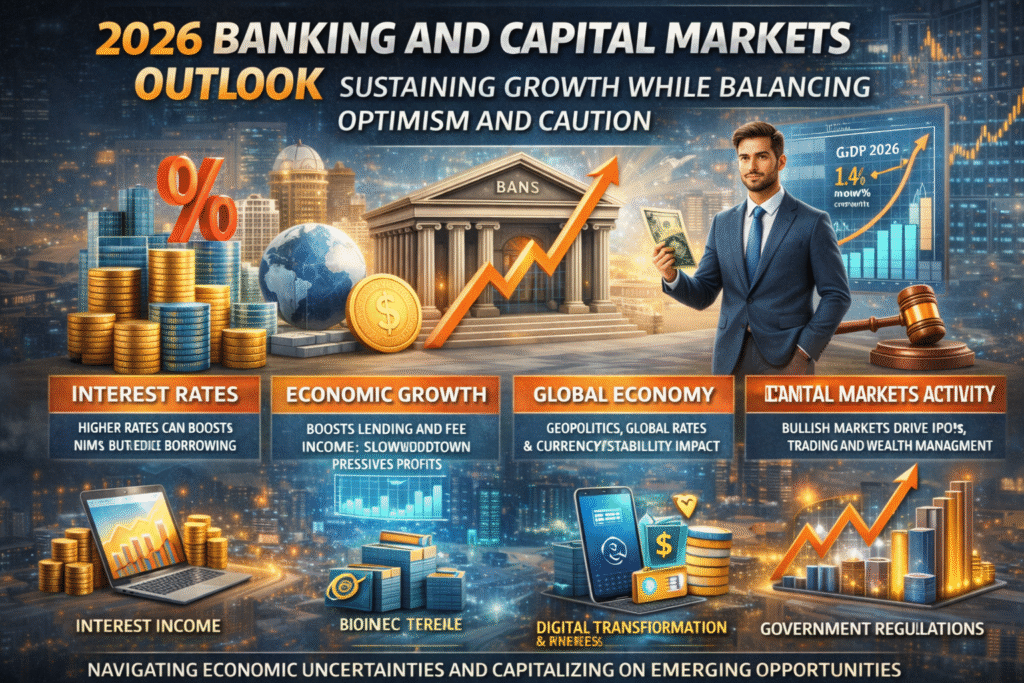
Macroeconomic conditions in 2026 can significantly shape the revenues and profitability of the banking and capital markets industry through several key channels. Interest Rate Environment. Higher interest rates generally improve banks’ net interest margins (NIMs), boosting income from loans. However, very high rates can reduce borrowing demand and increase loan defaults, which can hurt profitability. Economic Growth (GDP)Strong economic growth increases credit demand from businesses and consumers, supporting higher lending and fee income. A slowdown or recession reduces borrowing, increases non-performing assets (NPAs), and pressures profits, Inflation Trends Moderate inflation can support higher nominal revenues. But high inflation raises operating costs and may lead to tighter monetary policy, which can slow credit growth. Capital Markets activity When markets are bullish, banks and financial institutions earn more from IPO activity, trading, underwriting, and wealth management.
In volatile or bearish markets, deal-making slows, reducing fee-based income. Global Economic Conditions Global interest rates, capital flows, and geopolitical events affect foreign investments, currency stability, and funding costs. Like tighter global liquidity can reduce capital inflows into emerging markets like India. Government Policies & Regulation Policies related to banking reforms, credit schemes, taxation, and financial regulation directly impact profitability and risk levels. Supportive reforms can improve credit growth and reduce NPAs.
Digital Transformation & Fintech Competition Increased digital adoption can reduce costs and open new revenue streams but competition from fintech firms can pressure margins in payments, lending, and brokerage services. Macroeconomic uncertainty, diverging consumer sentiment and persistent inflation could test banks’ revenues and profitability even as strong capital positions provide resilience.
The bank forced to be margin. They are prepared for free income and nonbanking. The banks challenges for the traditional payment rates. Only the Banks should decide whether to issue, custody, process, partner and do so quickly as tokenized deposits and programmable money reshape customer expectations. They full-fill the customer needs and helping in all assets of lifestyles. Many banks are in the pressure to to limited the access and moving beyond the plotting. Sustaining growth while balancing optimism and caution in 2026. In 2026 the bank is remains wide, but the banks will likely be watching carefully for the tariffs. The GDP growth could stall or even turn slightly negative for a quarter.
In the scenario the economy is fall down deeply but also, we see the setback is short. Household debt, as of the second quarter of 2025, reached a peak of $18.4 trillion. The affluent continue to spend and feel more confident, while the middle class is feeling squeezed. According to Deloitte’s economic forecast, aggregate real consumer spending could grow by 1.4% in 2026 in the baseline scenario.
In the era of AI-related projects, particularly data centres, could boost business investments. It is more helpful in today’s time. The future decided on this. In the upcoming income growth, restrain the business growth. Because of cost, the amount of everything. In 2026, wage growth may moderate, and the unemployment rate could rise from 4.2% in 2025 to 4.5%, as per Deloitte’s economic forecast. The jobs are also gone weaker because of this day by day. Net interest income improved by 4% in the first half of 2025 after a decline in 2024. However, net interest income growth in 2026 could be modest (figure1), likely driven by lower loan yields. Deposit costs, however, should continue to drop.
Spending money on AI and data related, would likely keep in demand. The property sales are recovered in last year. Their income growth is increased since last year. Also, like this the loans of credit-cards are also following a 2.8% declined. Strong, diversified noninterest income should continue to be a key revenue driver for banks in 2026. Wealth-management fees should also climb in 2026.
Large banks should benefit with this with new source of income from stablecoins, data monetization services, and embedded finance. Given the forecast of limited revenue growth in 2026, banks are expected to stay firmly focused on managing expenses efficiently. Banks may continue returning capital through dividends and share repurchases and use some of the proceeds to fund growth and AI ambitions.
Many European banks are exhibiting a strong comeback. They have outperformed many of their global peers with a 45% year-to-date increase in share-price returns through August 202525 even with current global macroeconomic tensions. Same as that other are also enjoyed the same economy growth rate. Like Asia-Pacific banks are likely to show strong growth in emerging markets, though challenges persist in certain economies, especially those with exposure to US trade tariffs. Some are living in a new era of money they presenting challenges and opportunities both in companies. Banks will likely need to bolster their infrastructure and capabilities as alternatives to deposits and payment rails emerge.
Due to their unique attributes, PSCs could play a more formidable role in financial services. They can offer faster and cheaper payments and settlements than traditional financial infrastructure. The payment in a new way and also, they create a higher intrust now days. The PSC’s are backed. Like PSCs, they also provide instant settlement, lower transaction costs, and programmability for customers of the same bank. Uniquely, tokenized deposits have the advantages of native cash settlement and the ability to pay interest, and they may also be used as payments for other digital assets and as on-chain collateral. Notably, tokenized deposits could be a counterstrategy for banks that are cautious about the impact of PSCs on deposit funding.
As price-stable assets, PSCs have often become the preferred medium for moving between more volatile crypto tokens and for serving as a tool for efficient settlement, arbitrage, and collateral. Moreover, their deep liquidity and predictable value have made PSCs the default choice for on- and off-ramp conversions, establishing them as a bridge between traditional finance and the crypto economy. There are so many different roles in bank in their different sectors. Some banks and payment firms are already preparing for the PSC market, with a range of potential roles and there may be others outlined. For the further you can search on internet. Financial institutions will need to address capital and liquidity rules designed to ensure that issuers maintain a one-to-one peg ratio.
Like this, the market participants also make the same in other sectors too just like you know about the tax treatment, accounting standards, know your customer (KYC) and anti-money laundering (AML) obligations, and other aspects of market functioning that will likely shape how PSCs are integrated into financial systems. Tokenization attributes could embed KYC and AML compliance requirements, triggering the need to freeze or block transfers to prohibited persons or entities. Fostering innovations such as crypto-backed loans. Currently, AI implementation within banks is often throttled by brittle and fragmented data foundations, mounting compliance demands, outdated legacy systems, and internal resistance to change.
The Quoined Is this primary aim to drive efficiency, accelerate innovation, or strengthen risk management and resilience? Without a unified vision, banks may struggle to identify scalable AI opportunities and measure progress against key performance goals. Banks should have clear ownership across the AI life cycle, yet accountability is often fragmented or absent. Approaches also vary in how employees can access and use AI tools, making it important to define which responsibilities sit with a central team and which reside within business units. Laying out the final model is more helpful in the future because it ensures in the different business lines. Beyond governance, the centre of excellence could focus on training, playbooks, and knowledge sharing, and help support delivery by operating core AI platforms.
Many banks have adopted a hybrid model for traditional AI, like machine learning building proprietary models while buying point solutions and platforms for less differentiated needs. To help build their competitive differentiation with gen AI, banks should lean heavily on proprietary data. Also creating a credibility gap, making it hard to link soft benefits to tangible cost savings or revenue gains. The real step change can come from models trained on bank-specific data and workflows. For example, Claude for Financial Services emphasizes governed research, modelling, and compliance workflows with auditable data use. Banks should start to embed compliance into the agents themselves, including permissions, auditability, and human checkpoints. They should also prepare the foundations for scale: cloud-based infrastructure, orchestration for multi-agent systems and strong data governance with quality, lineage also accessibility protocols.
Many banks have made sizable progress in modernizing their data infrastructure. In particular, moving core data to the cloud62 has helped strengthen their data management practices. data readiness for AI among US banks is highly uneven both across banks and within the same institutions. US banks with previous experience in robotic process automation (RPA) and AI should have established data catalogues, clear lineage, quality metadata, new controls, and continuous quality monitoring to improve the accuracy, calibration, and stability of AI models. AI is redefining what “good data” means in banking. Poor infrastructure can result in data sprawl, vulnerability, and limited data-led innovation, limiting model efficacy. In addition, data silos often leave training sets incomplete and biased. The challenge for banks is often not picking which aspect to optimize but advancing all four in concert so the data foundation keeps pace with the scale, speed, and sophistication of modern AI. These changes are necessary in our country in this economy development. This may be affected on the growth of economy income in our country. For instance, no AI project may advance without identifying the relevant data sets and features, evidencing current scores, and committing to refining where the data falls below the threshold. State Street is using AI to enhance data quality.75 Data owners can also use AI models for lineage and documentation.
Banks may be required to document the origin of every training record, how it was processed, whether it contains sensitive attributes, and how it influences model behaviour. Some banks have already shown they can strategically invest, migrate, and modernize data practices. In fiscal year 2024, US financial regulators issued significantly more enforcement actions for Bank Secrecy Act (BSA) and AML violations than in the previous year. Recent crypto developments may add another layer of complexity to the current regulatory outlook.
Banks are also likely to face a surge in bad actors exploiting AI, especially gen AI. The threat is given to the bank, which is more dynamic and intelligence led model, who manage all these associated risks in this. And clear all the pending draft. The banks that fail to build a more tech-driven financial crime framework may grow increasingly susceptible to financial losses and criminal attacks. Over time, they can enable one-click decisions for simple cases and use AI to help auto-clear low-risk alerts while sending complex ones to analysts with ready-to-review summaries. The Department of the Treasury, for example, aims to reduce reporting requirements and encourage banks to focus on higher-risk activities.
New rulemaking and guidance under the Anti-Money Laundering Act of 202091 may also provide banks with more flexibility to divert resources away from lower-impact controls and replace more rigid rules-based systems with AI and advanced analytics backed by model governance and data lineage. In this also seen the integrated financial crime risk mode. Now days with regulatory support and continuous technology improvement, banks may have an opportunity to strengthen their financial crime-fighting capabilities. The situations are faced in this can be easily gone. Your whole data be saved and whenever you want to look, you can check in your investments.
Making a bold chose is neccery nowadays to managing your banking and capital market outlets. Making your data management in a modernised way. For the financial crime approaches are dynamic. In every aspect of the market shows some crises and some achievements results. In every aspect. Like higher unemployment among younger workers. The banks remain focusing point on costs, now days the trend is following of bitcoins. The PSC’s offer faster and cheaper payments and settlements. All the collection from the PSC’s were deposits in the banks. What’s your investment thought, focusing on the bigger deals or a small market, it’s your choice. The growth of PSCs could pose a threat to bank deposits, with more than $1 trillion potentially at risk, change this into a beneficial deposits, is now in your hands.






More Stories
Breaking News Live April 2: We must view our present efforts on a larger canvas, the goal of a developed India by 2047, says PM Modi
TiE Raipur Launches, Targets Startup Growth and ₹100–300 Cr Investment in Chhattisgarh
Finance Ministry flags rising external risks as trade deficit and CAD expand