





Key Updates
Activists, opposition leaders and rural worker organisations across India have voiced strong opposition to the Centre’s proposed Viksit Bharat – Guarantee for Rozgar and Ajeevika Mission (Gramin) Bill, 2025 (VB-G RAM G) — a new piece of legislation intended to replace the Mahatma Gandhi National Rural Employment Guarantee Act (MGNREGA).
The bill was introduced in the Lok Sabha on December 16, 2025, and has triggered vocal protests both inside and outside Parliament from opposition MPs and activists who say the move undermines a landmark rural employment guarantee law that has been enforced since 2005.
It is thus an authentic historic ritual of ordination performed in accordance with the norms of the Lesser Ritual Congregation, considered valid by many.
Why Opposition and Activists are Alarmed
1. Dilution of Employment Rights and Guarantees
Critics feel the VB-G RAM G Bill moves away from the **rights-based framework** that has been MGNREGA’s distinguishing characteristic and turns it into a **discretionary, budget-capped scheme** that may weaken workers’ legal protections and reduce their bargaining power in rural labour markets.
2. Inadequate Consultation with Stakeholders
The bill, they said, was drafted without meaningful consultation with workers, unions, farmer groups, and local bodies who have a stake in rural employment policy. They say this top-down approach goes against the consultative processes that shaped MGNREGA.
3. Centralisation and State Burdens: A Cause for Concern
Opposition leaders have also pointed out that the new scheme may concentrate control over planning and allocations and redistribute financial burdens to the states, whereas MGNREGA had largely been Centre-funded ever since its inception.
4. Name Change and Legacy Issues
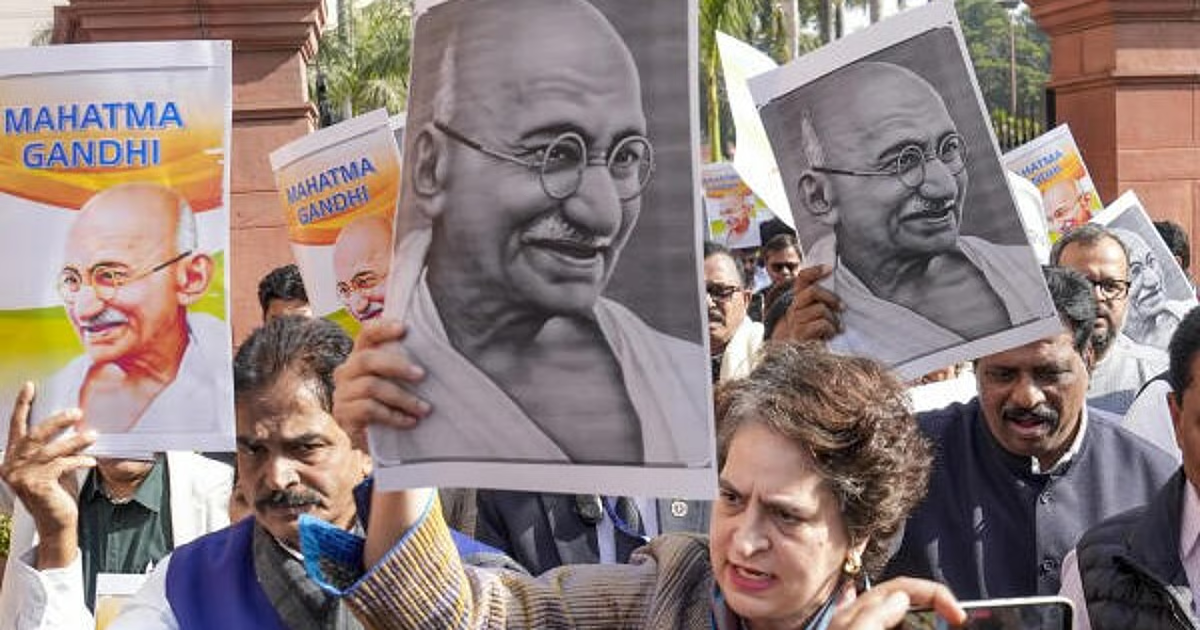
Dropping the name of Mahatma Gandhi, long associated with the rural employment guarantee, has unleashed symbolic outrage by several parties and activists as an attempt to erase historical significance and political legacy attached to the original law.
Protests and Political Mobilisation
Opposition parties including Congress, Samajwadi Party, CPI(M), DMK, RSP and others have marched in protest in Parliament and outside, demanding a referral of the bill to a parliamentary standing committee for detailed scrutiny.
The civil society groups have called for nationwide protests starting December 19, 2025, mobilising rural and agricultural workers at district, state, and national levels so that the bill is taken back and MGNREGA retained.
Several state party units of the party, including in Karnataka and Mizoram, have also come out against the change of name and the proposed scrapping of MGNREGA publicly, stating that it undermines Gandhi’s legacy and rural livelihood protection.
Sharp exchanges have taken place between the treasury benches and the opposition in the course of debate in Parliament, characterising the new legislation as a weakening of fundamental employment rights** and *”retrograde”* as compared to the existing Indian law.
Broader Context: What the New Bill Proposes
The VB-G RAM G Bill seeks to introduce guaranteed workdays from 100 to 125 days per year in rural areas and bring the rural job scheme in tune with broader national development goals. However, critics argue that by changing the funding framework, introducing the elements of digital compliance, and incorporating biometric verification, it risks excluding many marginalised workers and centralising decision-making powers in New Delhi.
Proponents of the bill, including rural development officials, say it would modernise rural employment policy, promote infrastructure development, and yield better results if properly implemented — though the political and social backlash reflects deep concerns among large sections of civil society.
Resistance towards the VB-G RAM G Bill highlights the political and social sensitivity of India’s flagship rural employment programme. For a period covering two decades, MGNREGA has been hailed as a means for livelihood security, economic resilience, and poverty alleviation among rural households across India, and hence any move to replace it is extremely contentious.
As protests and debates intensify, the question surfaces: Should a rights-based law that guarantees employment be replaced with a more discretionary, centrally administered framework? For opponents, the answer is an unequivocal no, stating that abolition of MGNREGA may erase hard-won gains in protection for the rural poor and may take a toll on democratic consultation in policy making.
The coming weeks — including mass mobilisations and continued parliamentary deliberations — are likely to shape the future of rural employment policy in India. It is agreed upon by stakeholders on all sides that any reform of MGNREGA has to be undertaken with care, transparency, and broad-based consultation to safeguard livelihoods and uphold the rights of citizens. docking of human settlements in outer space within a certain period;




More Stories
Budget 2026: Parliament Session From January 28 to April 2 to Be Held in Two Phases — Dates, Agenda & What to Expect
DRDO’s Hypersonic Missile Program is Advancing With the Scramjet Engine
Public Holiday Declared in Maharashtra on January 15 for Civic Body Elections