




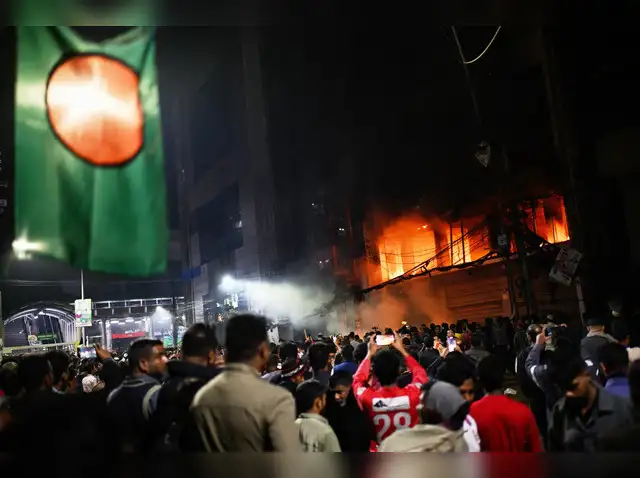
Widespread protests and violent clashes are sweeping across Bangladesh following the murder of prominent student leader Sharif Osman Hadi, further straining the country’s already volatile politics and relations with India.
The protests have been accompanied by widespread demonstrations, attacks against key institutions, and a mounting backlash against India.
“This is a signal that we have enough strength inside the country,” a politician said. “The elections are approaching. We do not want foreigners’ intervention again.
What Caused the Recent Violence
- Sharif Osman Hadi, a 32-year-old youth leader who led a major pro-democracy uprising, known as the 2024 pro-democracy uprising, resulting in the resignation of then prime minister Sheikh Hasina. He was immediately shot in Dhaka on December 12th and died of his injuries later in Singapore.
- His death sparked one of the strongest waves of protests in recent years, with thousands of people taking to the streets in support of demands for justice. Protesters have been venting their anger at various symbols of state power and foreign presence, such as Indian diplomatic missions.
Violence, Protests and Diplomatic Strains
- Clashes between security forces and protestors are reported to have occurred in Dhaka and other cities, with attempts to break into assistant high commissions in Chittagong and Rajshahi.
- The strength of the protests has also caused worries of further destabilisation, particularly regarding anti-India slogans and allegations spread amongst some of the protesting groups.
- The overseas government, headed by Nobel laureate Muhammad Yunus, urged citizens to keep peace and avoid mob actions in calling support for maintaining a democratic process.
India and Bangladesh: Ripple Effects
The unrest in Bangladesh has had spillover effects in India, with people taking to the streets in support of the unrest gangs or in reaction to related incidents:
- There were demonstrations in New Delhi and other Indian cities following the brutal lynching of a young Hindu man, Dipu Chandra Das, in Bangladesh’s Mymensingh district.
- Indian protesters assembled outside the Bangladesh High Commission in the Indian capital of New Delhi in a demand for minority security and punishment over the lynching.
- In light of the growing tensions and safety concerns, Bangladesh has shown concerns about the assault on its missions in India, formally registering its concerns with the Indian government.
Government Responses and Political Context
The interim government in Bangladesh has announced periods of national mourning and has stated that upcoming elections and the constitutional referendum remain a priority, despite the domestic unrest. The government has condemned violence and asked that law and order be restored.
As experts attest, the conflict also lays bare the deep-seated divisions in the government of the People’s Republic of Bangladesh that may be connected to politics and the rights of minorities in the country or distrust of democratic institutions. The conflict caused by the death of Hadi and the lynching has also heightened the diplomatic sensitivity between the government of Dhaka and the government of India.
Complex Crisis With Regional Implications
To say that the Bangladesh unrest sparked by the death of Sharif Osman Hadi has ignited mass protests and clashes that go beyond national boundaries. With ongoing rallies and heightened anti-India sentiment within some protesting crowds, the situation brings to the fore consideration that internal turmoil in politics has spillover effects on international relations, particularly in regard to neighbouring nations, both of which share historical and strategic relations. Both Dhaka and New Delhi are now faced with the dilemma of dealing with their own list of grievances while keeping delicate diplomatic engagements in sight – that of security, minorities, and stability. These are extremely trying moments for both Dhaka and New Delhi, especially when elections are around the corner.


More Stories
Budget 2026: Parliament Session From January 28 to April 2 to Be Held in Two Phases — Dates, Agenda & What to Expect
DRDO’s Hypersonic Missile Program is Advancing With the Scramjet Engine
Public Holiday Declared in Maharashtra on January 15 for Civic Body Elections