






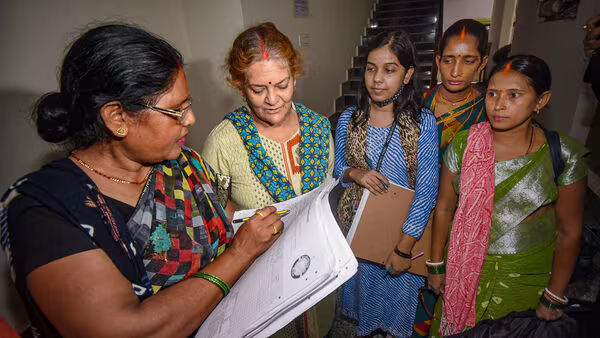
New Delhi: The Government of India has announced the first phase of its census in 2027, marking the beginning of the massive population exercise in the country. The preparatory phase of the census, known as houselisting and housing census, is scheduled to begin from April 1, 2026, to September 30, 2026, with every state having a 30-day fieldwork period in this six-month period.
Business Standard The first-phase notification was released by the Ministry of Home Affairs on 7th January 2026, thus marking the commencement of the decadal census activities that got postponed due to the COVID-19 pandemic in 2021. Business Standard
What the First Phase Involves
House Listing & Housing Census
The first phase focuses on accurately recording:
- All residential structures and housing units
- Basic household amenities and assets
- Housing conditions and facilities
Unlike the population count that follows later, this phase does not gather individual personal details such as age or gender. Instead, it prepares a comprehensive frame of all homes and buildings for the next phase of the census.
When and How It Will Be Conducted
- The house listing will be carried out at the local level in each region over a 30-day period determined by the respective state and UT governments between April 1 and September 30, 2026.
- A self-enumeration option will be available 15 days before the fieldwork begins in each area, allowing households to enter details online before an enumerator’s visit.
- This marks a digital leap from earlier censuses, as data collection will be conducted through mobile applications and central monitoring systems rather than traditional paper schedules — making Census 2027 the first digital census in India’s history.
Digital and Citizen-Friendly Features
The government’s notification includes new digital-centric improvements:
- Mobile app usage for enumerators and field data capture
- Online self-enumeration via web portal or app for citizens to submit basic household details in advance
- Real-time data monitoring and supervision through central digital platforms
These changes aim to improve data accuracy, speed up processing and reduce paperwork, ushering in a modernised approach to India’s largest statistical exercise.
Two-Phase Census: What Comes Next
The houselisting and housing census phase is just the first part of the broader Census 2027 plan. After this phase concludes, India will:
- Conduct Population Enumeration (PE) — collecting demographic, socio-economic, cultural and other personal data — across all states and UTs in February 2027, using the houselisting data as the foundation for fieldwork.
This two-stage approach helps organise the mammoth operation, ensures quality of data and streamlines logistics for the population count.
Why Census 2027 Matters
The decennial census forms the backbone of national planning and policy formulation:
- Updated population figures guide public policy, welfare schemes, infrastructure projects and resource allocation.
- Fresh data on housing, amenities and living conditions helps improve urban planning and rural development strategies.
- Reliable statistical information supports evidence-based governance and socioeconomic research.
Additionally, the 2027 census is expected to include detailed socio-economic and caste data at the population enumeration stage — the first comprehensive caste-related data collection since 1931 — a development likely to influence policymaking and affirmative action frameworks.
Conclusion: Beginning a New Digital Era of Census
The first phase of Census 2027—the houselisting and housing census—officially begins with the government’s January notification and will be conducted between April and September 2026 across India. With its digital-first approach, mobile app-based data capture, and self-enumeration option, this census promises to modernize India’s demographic data collection like never before.
By building a robust housing and household frame early, the government aims to ensure a smoother, more accurate population enumeration phase in 2027, supporting better planning, resource distribution, and governance for the next decade.
As millions of enumerators and citizens prepare for this nationwide exercise, the success of Census 2027 will be critical in shaping India’s developmental roadmap — from infrastructure investments to social welfare and electoral representation — in the years ahead






More Stories
Budget 2026: Parliament Session From January 28 to April 2 to Be Held in Two Phases — Dates, Agenda & What to Expect
DRDO’s Hypersonic Missile Program is Advancing With the Scramjet Engine
Public Holiday Declared in Maharashtra on January 15 for Civic Body Elections