





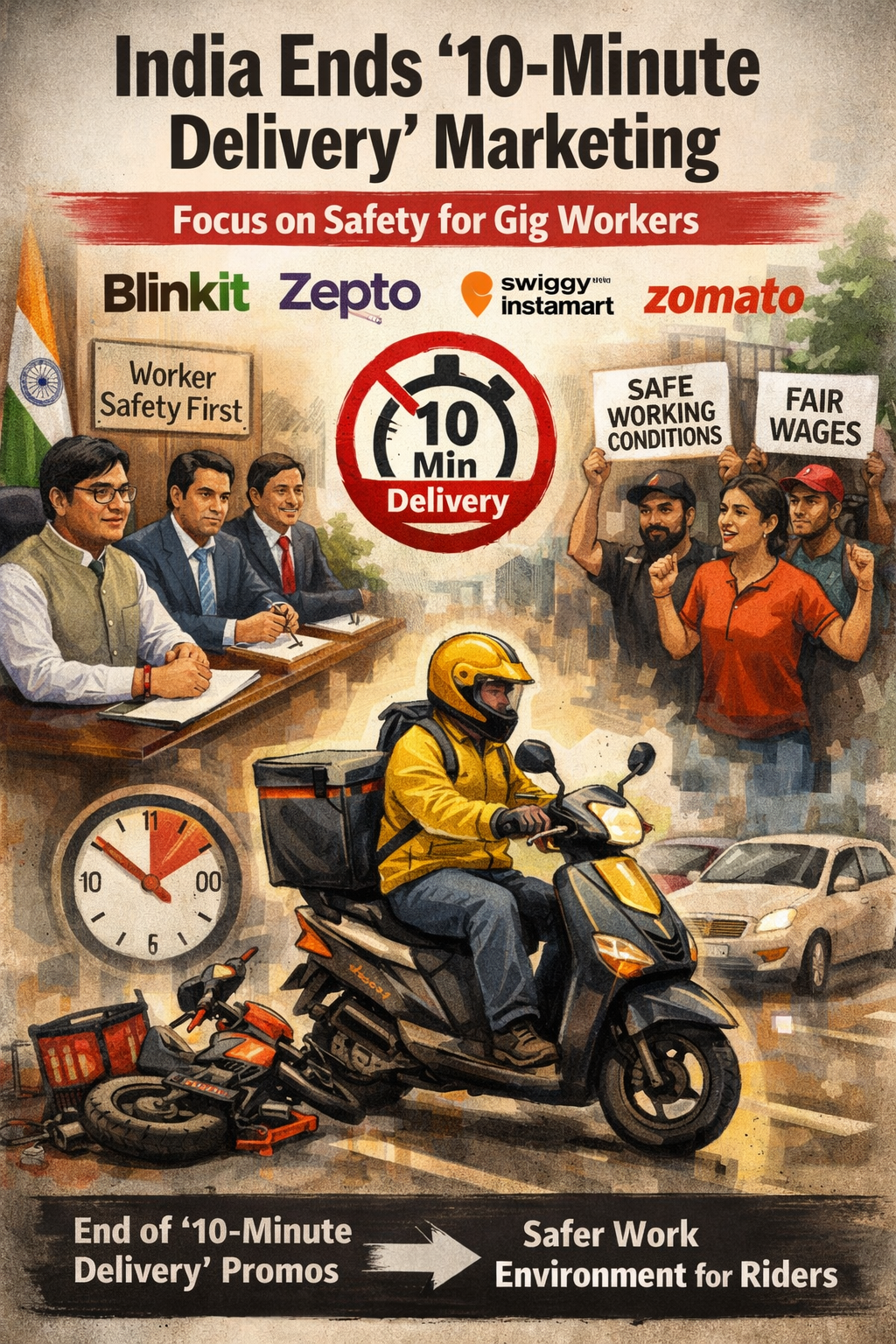
The Indian government is calling on quick commerce companies such as Blinkit, Zepto, Swiggy’s Instamart, and Zomato to discontinue advertising their capabilities to deliver goods in 10 minutes or less due to rising concerns that these unrealistic ultra-quick delivery time frames are challenging the safety of their gig economy delivery workers.
On January 13, 2026, Union Labour and Employment Minister Mansukh Mandaviya convened a round table discussion with executives from the leading quick commerce companies regarding the importance of prioritising the safety of delivery workers versus the speed of delivery marketing. Following that discussion, a number of companies pledged to stop using “10-minute delivery” in their promotional materials, applications, and branding. This represents a growing effort to bring accountability to an ever-increasing growth industry.
Significance of This Movement
The promise of 10-minute delivery has driven the exponential growth of quick commerce in India, bringing in new customers who expect immediate delivery of groceries and other essentials. This has also raised concerns from stakeholders, including lawmakers and gig worker unions, about the pressure that these rigid delivery timelines place on riders to work safely while completing deliveries and the negative effects that irresponsibly completed deliveries likely have on operations and worker conditions.
Worker Safety is the Top Priority
Riders are required to avoid dense urban traffic in order to complete deliveries within these extremely fast delivery timelines.
Safety advocates suggest that these promises create a culture and environment that rewards speed rather than safety, which increases exposure to injuries, job-related stress and accidents.
Recent strikes and protests by gig workers have highlighted the increasing dissatisfaction among delivery workers with respect to their working conditions, their compensation, and their unrealistic performance targets.
Industry Reaction
Blinkit has recently changed its marketing strategy to eliminate the 10-minute delivery promise from its tagline, instead focusing on product range and doorstep delivery.
Industry analysts predict that other platforms such as Zepto, Swiggy, and Zomato will adapt their marketing strategies to communicate the elimination of the 10-minute delivery promise shortly thereafter.
Industry analysts assert that while the change in branding will take place, the continued emphasis on providing fast delivery will remain. The focus of companies will be to meet the delivery convenience expectations of consumers while complying with the guidelines set forth by regulatory agencies and maintaining the health and wellness of their riders.
The addition of political and worker supporters for the new rules concerning gig workers establishes a win/win situation for gig workers and for those who promote safety for these workers. Raghav Chadha, MP for Aam Aadmi Party, publicly congratulated the government for this move and expressed that he felt the timing of many deliveries being promoted on the carrier’s delivery equipment and app timer had created a lot of pressure on riders to deliver within a very short period of time, therefore jeopardising the safety of the citizens at large.
Gig workers’ unions, including the Indian Federation of App-Based Transport Workers (IFAT) and the Telangana Gig & Platform Workers’ Union (TGPWU), also supported the government’s decision to eliminate time-bound promises and promote better working conditions and labour protections for gig workers.
While the 10-minute delivery model has been an effective marketing tactic since its introduction, experts believe that the elimination of a time guarantee will not significantly impair consumer demand because the rapid growth of quick commerce has created a large and extensive network of dark stores and logistics systems that will continue to be able to provide fast delivery even in the absence of rigid time guarantees.
According to market analysts, quick commerce is one of the fastest-growing sectors in retail in India, and it is expected to see continued growth across high-growth metropolitan areas. By establishing regulations that compel companies to adopt safer practices, it will also assist in the continued growth of this sector while encouraging improvement of the working conditions and protecting the labour rights of gig workers.
Safer, More Responsible Quick Commerce is the Way Forward for India
The Indian government’s recent reversal of its directive for “10-minute delivery” will have a large impact on the quick commerce model and represents an important first step taken by government regulators into the fast-growing sector. The government’s intent behind the directive is to reduce the pressures placed upon gig workers by removing claims of extreme speed and creating a climate of security and safety for workers and to encourage the establishment of sustainable business practices as the e-commerce market continues to rapidly grow in India.
While it is unclear how these changes will affect the actual delivery speed of products through the major platforms, the government’s action represents a turning point in prioritising the welfare of the employees over a mere gimmick of speed. The changes in policy will allow companies operating in the quick commerce sector to promote a more ethical view toward the gig workforce and promote safer working conditions for their employees. By making safe working conditions and profitability for the future the priority, the directive’s changes may serve to provide a framework for the balanced regulation of the gig economy in India.





More Stories
From Memes to Movement: The Viral Growth of Cockroach Janta Party
West Bengal votes in second phase of Assembly elections
Kashmir, spying, demolitions: How Modi’s India embraced ‘Israel model’