





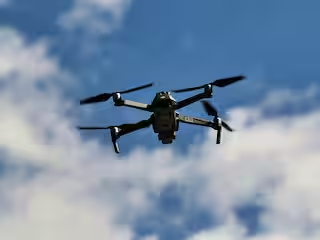
Multiple, ongoing sightings of unmanned aerial vehicles (drones) reported by security forces on sensitive sections of the India-Pakistan border in Jammu & Kashmir’s Poonch and Samba districts have prompted security forces, the army and the Border Security Force (BSF) to increase their vigilance over this area, which includes intensified counter-drone operations across the region and increased surveillance of the border.
Drones have been sighted on both camera and during night patrols, raising concerns regarding possible attempts to breach, provide contraband to or observe Border Forces defences. Although there have been no significant events connected to the drones as of yet, security forces have become more alert towards the presence of UAVs in frontline sectors.
Where drones were heard
According to reports, drones have been seen over the following areas:
_Poonch_ – This is an area of perpetual conflict (POC) along the LOF Line of Control due to mountainous terrain and regular ceasefire violations.
_Samba – An important border district to Jammu where there have been sporadic (periodically occurring) cross-border tensions. There is a need for precision surveillance.
Both of these regions are strategically critical to India’s ability to monitor their borders due to their proximity to infiltration routes and to the population residing next to them.
The Law Enforcement Agencies responded with urgency
In response to the sightings of drones, the Border Security Force Units & Army Patrols were enhanced along the fencing / OBSERVATION POSTS on the borders.
Both the OBSERVATION POSTS and the FORWARD POSTS increased their night surveillances and thermal imaging activities to identify low-flying aircraft.
Both Electronic Warfare Units & Radar Tracking Units have been asked to improve their ability to detect micro drone flights.
Although the precise intention of the drone flights remains the subject of investigations, the officials indicated that protecting the safety of border infrastructure and the public is a priority matter for them all.
Drones used near the border could have various reasons depending on security analysts. Drones have been used to move drugs, small electronic devices and other items across fencing and without using heavy equipment checkpoints in some border areas. Drones can also monitor troop movement, observation posts and patrols which can provide hostile elements with intelligence. Drones may also be the result of poor navigation systems or civilian drones that have drifted across the border accidentally. All of the above explanations are currently being investigated; none have been verified.
The India-Pakistan border is one of the most dangerous and heavily guarded borders in the world, especially in Jammu & Kashmir, where frequent ceasefire violations can lead to small arms fire. Additionally, hostile forces may benefit from being able exploit gaps at the border caused by hostile forces engaging troops at the border. Finally, there is a requirement to secure the fence line, bridges and forward posts as well as the more than 1.2 million civilians living in the vicinity of the line of control and the international border. Consequently, even non-military incursions, such as drones flying unarmed over the border, are viewed by Indian law enforcement as serious violations of Indian national security.
Threats to Air Traffic
- To detect aerial threats, radar systems are capable of monitoring low-altitude flight corridors.
- Thermal imaging and night-vision devices are able to see and track Aerial threats such as small drones.
- Electronic countermeasures such as jammers are placed in sensitive areas to stop/control drone/communication signals.
Rapid response teams and quick response platoons have been put on alert to respond immediately to any aerial threats in sensitive areas.
Officials emphasise that multilayered detection and response systems will be essential to prevent developing aerial threats along the U.S.-Mexico border.
Local governments in these affected areas have been instructed to:
Observe with an active eye in border village areas.
- Completely cooperate with BSF personnel in ensuring all community members are educated and able to quickly report perceived suspicious aerial activity.
- Ensure local law enforcement agencies and disaster response teams can react to any escalation of the use of drones for malicious intent.
- Cooperation from local communities will act as a valuable complement to the official security response systems.
As a result of the recent increase in drone sightings over areas along the India-Pakistan border, both India and Pakistan have raised their level of alert for potential incursions into their territories by using unmanned aerial vehicles (UAVs). The sightings of UAVs along these borders are reminding all involved that the next phase of security challenges must be taken into consideration and will also require further involvement of the Ground Forces (Army) and Air Force (IAF) of both nations.
There are currently ongoing investigations regarding where these UAVs originated from and what type of aerial activities they may have been performing in areas along the respective borders. To prevent misuse of such UAVs, new counter-UAV surveillance methods are being developed by government agencies, and increased counter-UAV methods are currently being implemented by government agencies in the border districts.
Given current geopolitical and technological dynamics and the possibility of future conflict, continuous vigilance, rapid detection of offensive UAV incursions, and the establishment of an effective joint defensively coordinated defence mechanism will be





More Stories
Nitin Nabin has been named the new International President of the BJP; he will be confirmed at a high-level meeting of BJP functionaries very soon.
Maharashtra Civic Polls 2026: BMC Elections See Thackerays vs BJP-Shiv Sena & NCP Alliances as Mumbai Votes for the First Time Since 2017
India Urges Quick Commerce Firms, such as Blinkit, Zepto and Swiggy’s Instamart and Zomato, to Stop Using “10-Minute Delivery” as a Marketing Tool Due to Rising Concerns Regarding Safety