






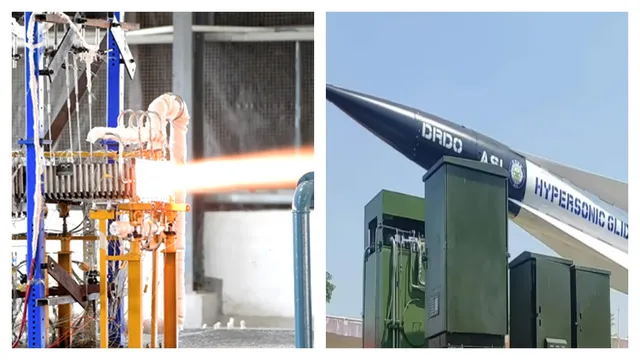
India’s Defence Research and Development Organisation (DRDO) has achieved many new records with its hypersonic weapons programme with the successful testing of the scramjet engine, which is an important component of hypersonic flight for sustained periods of time. With this latest achievement, India is now part of a very exclusive group of nations that have developed and deployed hypersonic cruise missiles (which travel at speeds exceeding Mach 5, or five times the speed of sound).
The DRDO’s hypersonic propulsion system has been developed as part of the High Drag Aerodynamics Program, which includes scramjet engine validations conducted at supersonic combustion ramjet (scramjet) levels. These air-breathing missiles have the capability of travelling at sustained high speeds within the earth’s atmosphere and therefore are more difficult to be detected and tracked than other conventional types of military missiles.
What Hypersonic Missiles are and the Role of Scramjet Technology in Their Development
The scramjet (supersonic combustion ramjet) propulsion system is a fundamental technology enabling high-velocity missile systems of the future by providing:
The ability to burn oxygen from the surrounding airstream at supersonic speeds. Without an oxidiser, the scramjet power plant can produce considerable thrust during sustained acceleration.
Rapid acceleration of missiles operating at Mach 5 to Mach 10+ while travelling through the atmosphere and enabling sustained high-velocity missile flight.
Less reliance upon heavy rocket motors and associated components; therefore, providing improved agility and distance travelled, among other benefits.
DRDO scientists have conducted flights during which they successfully demonstrated scramjet combustion. Their results permitted them to validate multiple critical engine design components and airflow management systems — both required to perform follow-up flights to evaluate hypersonic performance.
Hypersonic Capabilities Are Extremely Strategic
Hypersonic missile systems are very effective strike platforms for their speed, range and agility. These capabilities offer several advantages over conventional weapon systems, including:
Speed and Precision—Hypersonic missiles can hit targets from several hundred or more miles away in minutes, considerably reducing the amount of time available for adversaries to assess the threat level and increasing the ability of the user to respond quickly.
Increased Survivability and Evasion — Due to their ability to fly very fast and to operate at multiple altitudes, it is extremely challenging for existing missile defence platforms to interact with these weapon systems.
Increased Technology Advantage — By developing new propulsion and guidance systems, India has come closer than ever to the advanced military aerospace capabilities of many countries throughout the world and has closed the gap with those countries that have fielded operational hypersonic weapon systems.
Many of India’s neighbours, as well as several major military powers, are also currently investing heavily in hypersonic technology, resulting in fierce competition within this critical technological arena.
DRDO’s Future Directions
While DRDO’s scramjet testing is an important step, full integration into an operational hypersonic missile will require:
Tests of the complete propulsion system, combining the boost and scramjet cruising phases.
Validation of hypersonic flight speed performance during combined flight test.
Development of the following advanced missile systems to accommodate extreme temperature ranges: guidance systems and thermal protection systems.
DRDO will execute incremental hypersonic flight evaluations prior to deploying an operational hypersonic missile system, and these evaluations will measure actual performance factors such as airframe strength and missile guidance using autonomous guidance units at exceptional aerodynamic loads.
Overall Defence Implications
Hypersonic weapon systems will substantially affect how nations use military power by providing:
A strategic deterrent capability against nations’ highest asset military forces.
Swift first-strike options when employed in a conventional as well as an asymmetric environment.
Increased stand-off attack capability, significantly reducing the threat to launching platforms.
As a complement to India’s existing missile options, these weapon systems can be positioned in layers from short-range ballistic missiles to cruise missiles, thus allowing for many different conflict scenarios as a solution to the battlefield and tactical environment in addition to expanding strategic options.






More Stories
Samir Soni reacts as the internet calls Amitabh Bachchan the real villain of Baghban: finally, some redemption
Blinkit CEO Deepinder Goyal Steps Down; Albinder Dhindsa Appointed to Replace Him—What It Means to Blinkit
ICC Dismisses Bangladesh’s Request for T20 World Cup Venue Change: Here’s What Went Down