






India’s education system is one of the largest and most diverse in the world, playing a crucial role in shaping the nation’s future it also Guided by policies such as the Ministry of Education and the reforms of the National Education Policy 2020, it aims to provide inclusive, equitable, and quality learning opportunities for all. The system covers multiple levels from primary schooling to higher education across urban and rural regions, catering to millions of students from different social and economic backgrounds. In recent years, there has been a growing focus on skill development, digital learning, research, and innovation to prepare students for global challenges. Despite challenges such as access gaps and resource limitations, India’s education system continues to evolve, striving to empower youth with knowledge, creativity, and critical thinking for national growth and development.
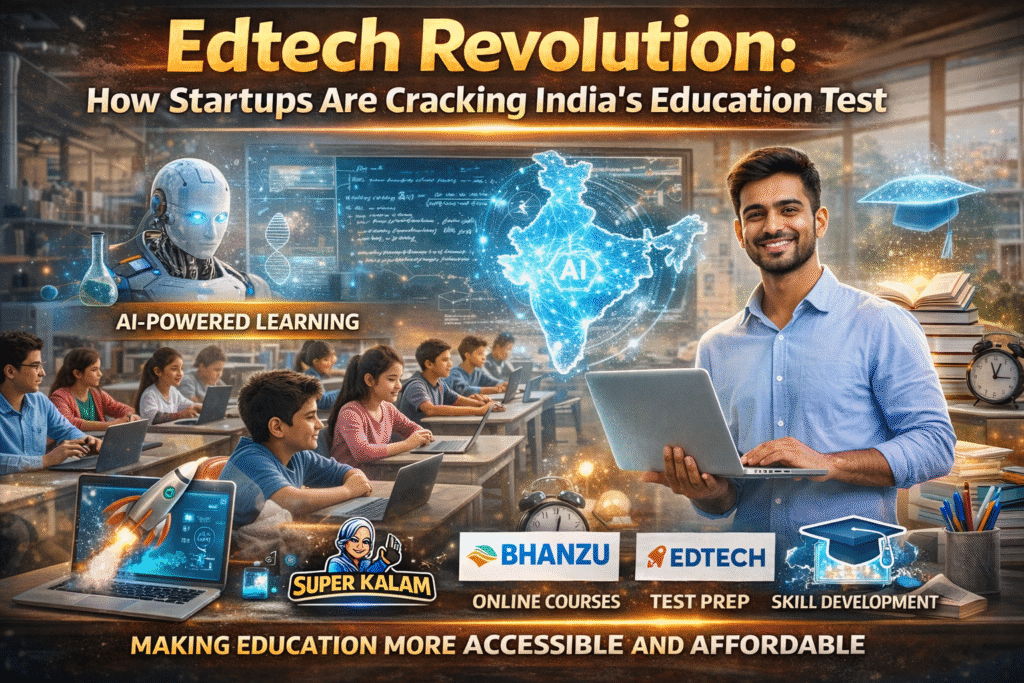
Our educational sector is touching the limits of the sky, nowadays the competition is very hard and very challenging in our education system. Everyone runs in the rase of higher scoring. India’s edtech sector is booming, driven by AI innovations amid insufficient government funding. Startups like Super Kalam and Bhanzu lead in AI-powered test prep and math education, teasing a future of more accessible and quality education.
In the last few years our education system is in strong innovation. 85% of students have been involved in learning and what outcome is coming. Now days the target scoring in exams are set. Reasons like engaging content and high-quality educational resources are leading edtech demand in the country, but that’s not all that’s fuelling it. Throw startups people creating their own business’s.
They say that, “We are not dependent on humans for doubt resolution, multiple choice questions’ evaluation or content creation. By removing humans as a variable, we are making the entire learning experience infinitely scalable,” which creates to knowing or experiencing new society. EdTech’s in India are also flourishing amidst insufficient government funding for the education sector. In this for the higher studys of students, government also played a very crucial roll in this and lunching such a good scream in educational sector for the students, providing all the assets to poor children for the study. In a hope of they become a good artist in the future. students changes the history of this country.
If we see in our educational sector all over so our Per the Ministry of Education’s data for 2023-24, 48% of teachers at the pre-primary level are unqualified, while 12% of teachers from primary to secondary levels lack professional training. Most edtechs are aimed at upskilling, but the current scenario signifies a deep demand for an overhaul of the educational infrastructure. Over the seeing everything about the student’s dedication and moving forward in the nation. Further, the pandemic worsened K12 education for students, both in India and abroad.
Startups like in different sectors. Such are significant strides in math education is Bhanzu, which started as a Telangana government initiative during the pandemic. Neelkanth Bhanu, co-founder of Bhanzu, says, “We teach foundational math via our proprietary pedagogy, which increases a child’s arithmetic speed 4x, making them do exceptionally well in school and apply math in the world around them.” His great thinking on education.
Online learning is as effective as offline classes. We get to have children from different parts of the world interact. I think cosmopolitan exposure is usually lost in offline setups. Drawing on his experience with education-sector startups, Super Kalam’s Rathore recognised the gaps faced by competitive exam aspirants. This insight shaped the company’s approach, leading it to focus on personalised guidance for test modules and structured monthly target planning. He says that “I guide students here at Super Kalam in framing their daily targets and being consistent and disciplined. They will usually encounter different kinds of distractions, so I guide them on maintaining a sense of discipline for at least 4-5 hours a day. I also provide empathetic, mental and emotional support,” says Sharma.
Make the education accessible, some programs are on education which promote the education system and give power and positivity to the students for making themselves a good person and a big business man. In this some programs are taking places like the Samagra Shiksha Abhiyan, providing funding for education from pre-school to Class 12, heavily depend on state funding. The main focusing sectors of this are The industry heavily targets K12, test preparation and skill development often for Tier-2 and Tier-3 cities. Government supported in the educational system, they motivate the students and launching new screams for this new generation. Initiatives like the National Startup Awards recognize innovators, supported by funding from the Startup India Seed Fund Scheme and Fund of Funds.
There are so many challenges also facing in our education system like, despite growth, the industry faces challenges in trust, with some startups failing due to a lack of collaboration with traditional teachers. India’s edtech industry is booming, fuelled by AI breakthroughs as the government underinvests. Startups such as Super Kalam and Bhanzu take the lead in AI-enabled test preparation and maths education, whetting a prospect of greater affordability and quality of education.
Almost 85% of students credit better learning outcomes to edtech platforms in India, as revealed in an Internet & Mobile Association of India (IMAI) report entitled, Impact Study of Edtechs in India: Driving Innovation & Creating Opportunities. Now days this is in a peak of the world to be educated and be creative. Factors such as compelling content and quality educational resources are driving edtech demand within the nation, but it doesn’t stop there. While Union Budgets in the past focused on building more infrastructure for top education institutions, primary education basis of students does not gain much attention. In addition to that, the pandemic further degraded K12 education among students in India and across the world.
The explosion of edtech startups in India is a big representation of the status of the education industry in the country, with the startups vying to bridge the gap caused by a shortage of qualified teachers. In 2023-24, the dropout rate from secondary school in India was as high as 10.2%, as per government statistics. It impacts 26% of learners in today’s education system. the current Union Budget this year raised the estimate of expenditure on education by 12.5% (to ₹1.28 lakh crore) compared to last year’s revised estimate. Overall, however, taking a broader perspective, data from PRS reveals that education as a percentage of expenditure has experienced a major decline from the 19% it received in 2015-16. Education is a concurrent subject wherein the state and central governments must coordinate.






More Stories
Solar stocks crash: Waaree Energies slumps over 14%, Premier Energies down 12% as US tariffs bite
Sam Altman plays down AI water-use claims, says energy is the real issue
‘Safety-first’ mindset accelerates transition of high-end technologies in mass-market vehicles: Techarc report