



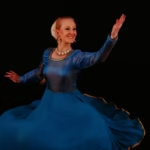


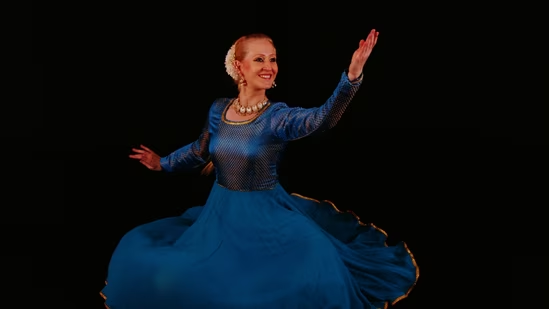
Enhancing your skills and finding your way of living is, most importantly, part of life. whether it is dancing, singing, art, travelling, swimming, playing any sport, or anything which is your interest. It gives you a career in life. Always focus on achieving your goals in life because once you become older and older, you can’t pursue more of your interests or hidden talents. Like this German dancer explains the true meaning of dance. Like dance as a worship here.
Everyone wants to learn something new. Understand the concept of immersive learning from a German Indian classical dancer with over 20 years of experience. Anne Dietrich, a German and Mohiniyattam and Kathak, explains the importance of immersion and the guru-student relationship in order to learn classical art forms. With the focusing her passion, she is also never forgetting the respect of a relation in between the student and teacher. Always put your instructor first in every aspect in every field. She does the same.
The art has always been an innate mode of expressing ideas and thoughts across media. In today’s interconnected world, globalisation and the internet have made this exchange of thoughts and ideas almost effortless. Even in the absence of a common language, people across continents effortlessly decode trends, pop-culture expressions, and generational slang with striking ease. In today’s hyperconnected digital age, cultural cues transcend borders in seconds, whether it is Gen Alpha’s delightfully absurd “67” humour, Gen Z’s nostalgic fidget spinners, loom bands and bottle-flip obsessions of the mid-2010s, or millennials who grew up looping their lives through Vine clips. Ideas, emotions, and identities now travel at a supersonic pace, propelled by the internet’s vast and ever-evolving channels, binding diverse audiences together in a shared global conversation.
Our culture is very wide and has so many different lines to achieve. Many are in the dance fields, too. To create powerful performance in dancing, all we need is our body, mind, aim, focused each and every thing be on target, as we learn. On what we learn. We need to take a step-by-step approach to move deeper into your achievements and towards your targeted goals. From a small level, we start, and after that, we see what the results show. Sometimes dancing is like a worship for so many people and for all the dancers. Just to know if it’s the right way to follow your dream? In my opinion, yes, it’s good to follow your dreams. Dream big and achieve them.
Students enjoy this and felling relax from the world stress. The dancing expresses the nature of your feelings, and it helps you keep fit and healthy every time. When you feel upset, when you get bored, when you feel storming inside you, when you feel lonely, when you express your emotions, when you want to show story or anything, it could be anything you can express through dancing.
So many dancers are practising every day to achieve higher and higher goals. Set the target first. This German dancer had a tragedy with them, two decades back, when the internet was still in its infancy and not as widely accessible, and most knowledge existed in physical formats such as books, letters or word of mouth. At the time, shared consciousness was also not prevalent, as globalisation was yet to turn the world into a fully connected village.
Now, meet German dancer Anne Dietrich, who has spent more than 20 years deeply engaged in Indian classical dance forms such as Mohiniyattam and Kathak. In an exclusive interview with HT Lifestyle, she gave her insights on her beautiful artistic journey, demonstrating how, twenty years ago, she commenced her journey of immersing herself in a traditional art form and learning that it demanded rigorous training and discipline. This spends time in a two-dance with two different culture one is kathak the Indian classical dance, and the second one is Mohiniyattam, which is from the state of Kerala in southern India.
Anne trained in contemporary dance. It further reinforces that word of mouth remains one of the oldest mediums of cultural exchange, and for Anne, it proved to be true as well. She recounted the beginning of her journey. “I got to know classical Indian dance through a friend, and I applied to Kerala Kalamandalam in South India.”
Further, her fascination with the art form was deeply influenced by its uniqueness and profound expressive power. Reflecting on her journey, she shared, “I became truly captivated because Indian classical dance is so rich in expression you communicate through nuanced facial movements, abhinaya, intricate gestures and mudras, and through them, you can narrate an entire story.”
She mentioned how back then, there was no Instagram or YouTube to gain an immediate understanding of the experience. She stayed in a village in South India, underscoring the importance of lived experience in the process of learning. She spoke profoundly about the traditional guru-shishya-Parampara, the lineage of knowledge passed from the teacher (guru) to disciple (shishya).
She mentored under prestigious masters like Prof. Kalamandalam Leelamma at the Kerala Kalamandalam in Kerala (Mohiniyattam), Padmashree Bharati Shivaji. She discussed about the co-founder of the Centre for Mohiniyattam in Delhi. Respected Geetanjali Lal in Delhi, with whom she has been studying Kathak since 2009, along with additional training with Pallavi Krishnan and at the Lasya Akademi in Trissur. She always prays to her master because she starts a dance practice. She never fails to skip the dance practice on any day.
She puts her master first, then she is a hardworking student, with all his devotion and heart devoted to the dance and its career. She always encourages herself because life is fun its for following your goals and desires. She never becomes bad in any aspect of life. She performed well in big programs, too. The dedication, if you have, so it’s like this. Prepare your body to be flexible and your mind focused on one place.
Her experiences give motivation for all of us. Like one thing, mentorship. While one may gather surface-level information from the information available to them, true immersion and learning require guidance and consistency. Seek out experts if you really wish to master any artform.
What do you think? Share your disagreement and experiences. One thing her journey proves is that mastering art cannot be rushed. Mastery is not achieved overnight; it is cultivated over years through rigorous training, unwavering discipline, and the guidance of the right mentors. The most meaningful insights come from seasoned experts, so if you truly aspire to excel in any art form, seek their wisdom and learn from their experience. One of the master pieces in the world. A proud moment for her parents. Also, her parents appreciate her for focusing on her aims what you want to do in future.
However, for Anne, it is much more nuanced. She offered her perspective on blending art forms. Instead of viewing it as a fusion, she described the process as something more gradual: “I don’t like the word fusion. I feel it is more about letting the classical style slowly melt inside the body through years of training.”
Whether it is dance or any other skill, true depth grows through patience rather than quick fixes or surface-level experimentation. Even with prior training in another style, as in her experience with contemporary dance, genuine mastery comes from adapting and immersing oneself consistently. Existing knowledge may help, but it can never replace the discipline needed to truly learn and embody an art form. Anne’s advice for the youth includes stepping away from constant digital distraction and choosing more fruitful entertainment, which is rooted in live art and cultural experiences.
In everyone’s life, there are multiple takeaways from her journey for all of us to part with. First is that learning requires curiosity, patience, commitment, and mentorship, instead of quick, surface-level exposure. Next, learning also requires adapting, observing and internalising the art instead of just performing and training. Instead of a quick blending of styles (fusion), she advocates for letting the classical style “slowly melt inside the body” through continuous, dedicated training. Her journey included training at Kerala Kalamandalam and under specialised Gurus, emphasising the importance of the Guru-Shishya tradition.
Authentic learning of a new, complex art form requires overcoming the urge for immediate results and dedicating years to mastering technique. Dietrich’s experience demonstrates that learning Indian classical dance for a Western practitioner is a transformative journey of cultural immersion, requiring deep respect for tradition and a commitment to long-term discipline.
From Gen Alpha’s inane 67 humour to Gen Z’s fidget spinners, it is amazing and capable of getting praise. This generation really wants to achieve higher dreams. She is an amazing dance performer. Also getting lots of praise from everyone.




More Stories
Virosh Premier League: Did Rashmika Mandanna, Vijay Deverakonda take inspiration from Parineeti Chopra?
Media & Entertainment industry – Key tax issues and expectations from Budget 2018
Ananya Panday Drops A Heartfelt Birthday Wish For Rumoured Boyfriend Walker Blanco: “You’re The Best”