


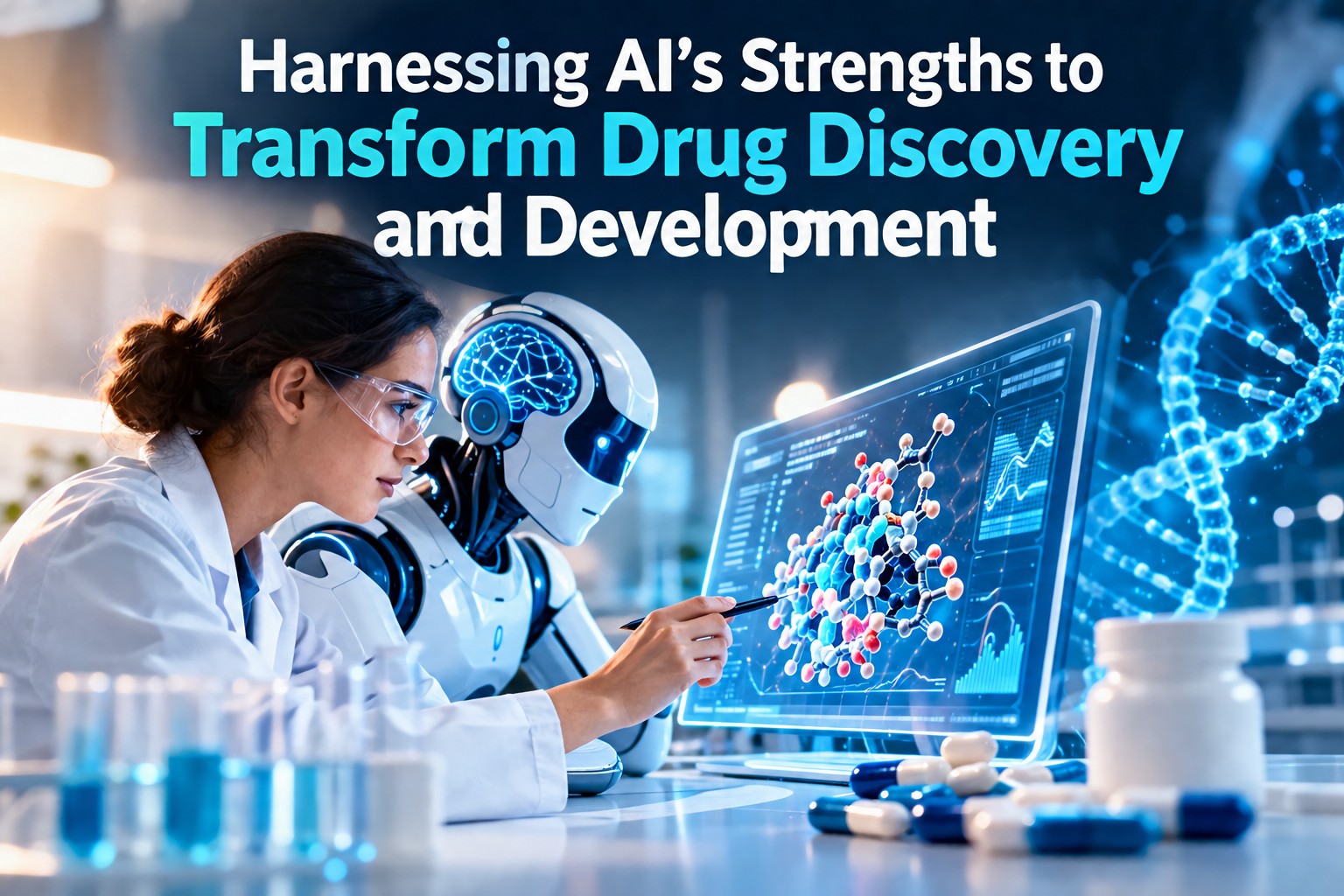
Indeed, artificial intelligence is becoming an increasingly potent resource in the field of pharmaceuticals with an enormous potential of changing completely the process of new drugs’ discovery, testing and development. Still, in order for AI to have a considerable effect on the field of drug discovery, the latter should not be viewed as the substitute for human knowledge, but rather the technology that will be used for those aspects where AI outperforms humans.
It is widely known that the process of discovering a new drug is long and costly. In order to discover a new drug, numerous molecules need to be considered, and only the most promising candidates are chosen based on their biological activities and safety. Artificial intelligence is capable of making the process much faster because of the possibility to analyse huge amounts of data within a much shorter period than any other traditional method.
The primary advantage of AI is the ability of machine learning systems to discover patterns within large datasets which include genomics, molecular structures, biological data and even scientific researches.
On top of that, the AI may prove useful in repurposing drugs, by analysing already existing medications and discovering applications of different medicines for various diseases. In this way, scientists could find ways to apply existing scientific knowledge in order to make the process more efficient.
However, one should keep in mind that the AI cannot replace scientists in their work. Development of medications is a process that requires taking into account numerous biological peculiarities, clinical uncertainties and ethic aspects – the areas that are beyond the capabilities of artificial intelligence.
In reality, the real potential of AI lies in collaboration with people. Scientists will be able to take advantage of domain knowledge, creativity and critical thinking, while AI will assist them with its speed, scalability and high-level pattern recognition.
If pharmaceutical corporations pay attention to these qualities, AI will not only become a new technological trend, but also an effective tool for discovering new medications.