




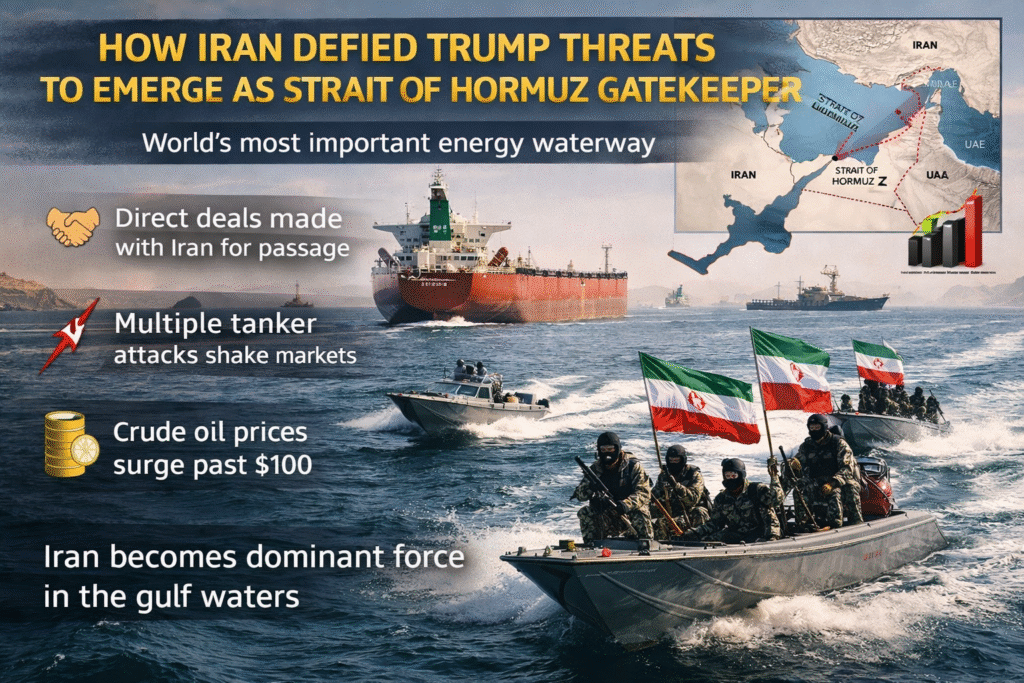
As United States President Donald Trump tries to build a coalition of navies willing to open the Strait of Hormuz. Many other countries are doing business in a different style, like in some areas, some countries are negotiating safe passage directly with Iran, underscoring a new de facto reality. The trading system continues to go on for a long time.
The traders are exchanging their stocks in large amounts. Like the analysts, we understand that, regardless of military results, Tehran is calling the shots on who gets to use the world’s most important energy waterway. The direct deals are held. And new trading styles are going on.
Did you know that after US-Israeli strikes on Iran began on February 28 and killed Supreme Leader Ali Khamenei, the Iranian military leadership responded by focusing on its most potent form of leverage. It is proven by Iran’s geography. The country wants to go on the no one position.
The traders are dealing with good negotiations with them. So, this country controls the northern shore of the Strait of Hormuz, through which 20 per cent of global crude oil and natural gas supplies pass. The roots are very controllable in that country, and each and everything is well managed.
The northern shores are strait. Large ships come and go easily, and the trading is held in a proper and correct manner. It is 33km (20 miles) wide at its narrowest point, so any naval force that wants to cross it becomes easy prey for Iranian attacks coming from the mainland.
A limited number of attacks on vessels in the strait and even the mere threat of such incidents has been enough to shake market confidence, reflecting insurers’ low tolerance for risk. As a result, insurance premiums have surged sharply, leading to a near standstill in maritime traffic. Since the conflict began, around 20 vessels have come under attack.
Iran has detected the terms of passage through the Strait. Now they are putting the gatekeepers for the checkpoints. Andreas Krieg said about this, “This will elevate the status of Iran in the geography of the Gulf”. An associate professor in Security Studies at King’s College London and a fellow at King’s Institute of Middle Eastern Studies.
The vessels are attacked, and Iran detected the passage. Some attacks are so large that they shake the markets. The markets have to think about what the result of the stocks and deals will be, and then anything is finalised. This will be the new reality for the foreseeable future, he added.
Not only this, but also you have also seen Crude oil prices have climbed past $100 per barrel, over 20% higher than levels before the war, prompting countries to carry out the largest emergency reserve releases on record.
Gas prices have risen by more than 40 per cent since the war began. On this, Trump initially floated the idea of ordering the US Navy to escort vessels through the waterway. The higher prices of crude oil are also detrimental to the population. It is not beneficial. He then appealed to some countries to send warships and warned NATO members they would face “a very bad” future if these allies failed to help in opening the strait.
However, the appeal was largely rejected or met with vague responses. Japan stated it had no intention of deploying naval forces, while Australia also declined to send ships. The United Kingdom signalled it would avoid involvement in a broader conflict, and Germany delivered a blunt response, saying, “This is not our war.”
On Saturday, two India-flagged gas tankers passed through the strait after days of negotiations between New Delhi and Tehran, including a phone call between Indian Prime Minister Narendra Modi and Iranian President Masoud Pezeshkian. Ships from Pakistan, Türkiye and China also transit through the Strait of Hormuz. The calls are very necessary for clearing the conversations and the decisions that are taken by the combine both the ministers. All this is happening for the reshaping of the country and enhancing the country, making it super self-dependent. The country ships the goods and materials through the waterways, which is very helpful for us.
The Financial Times has reported that Italy and France have also reached out to Iran. Is only for deals, although Italian authorities have rejected making such an overture. Three countries have reached an agreement and made all three countries helpful trading partners. They are self-dependent. We heard that in future they are having very bad struggles, so they need to be well prepared.
They have to make some preparations for the future. Windward, a maritime intelligence tracking group, said that while traffic in the strait on Tuesday remained 97 per cent below average. The main trafficking is in the tracking group. The average percentage is very good. This does not need to be changed. But the system of trading is rejected by some countries, which is not good for any country.
The trading is doing throw the water root and a growing number of ships have been passing through Iran’s territorial waters, suggesting that Tehran is allowing “permission-based transit”. The permission is allowed only when it happens. The average rate is going on a nice number of percentages. It is 97 per cent.
It’s all about the US that they decide to have the US naval forces to escort convoys through the strait, dating back to the Iran-Iraq War in the 1980s. But today’s scenario is different. Coming back to the wars between these two. In the previous time. Now the time has changed. The ships are very fast.
When the trade is done, it then goes back to the US. While it was backing Iraqi leader Saddam Hussein, it was not a direct party to the conflict. At the time, Iran was still navigating the turbulent aftermath of its revolution and working to consolidate authority. While its Islamic Revolutionary Guard Corps remained far less structured and developed than it is today. Iran was still navigating after all this happened. For this, they also need to take permissions. Because in some countries, the trading system is rejected even in today’s time period. The ships are still navigating.
If you see the condition goes in depth about this, you will definitely find that Iran has drones that its factories are capable of producing on a large scale and has been using them. The early proof of anything there. So that the citizens are comforted. They largely they annoused the decision for the country. Iranian forces could also use small boats to assault tankers, deploy mines and engage in other guerrilla-style tactics.
Amid conflicting reports over whether Iran has deployed mines in the strait, experts say such a move would likely prove counterproductive for Tehran, as it would disrupt all maritime traffic, including its own vessels and undermine its ability to control which ships are allowed to pass.
In that country, the officials are aware of their geographic advantage. “This is up to our military to decide,” Iranian Foreign Minister Abbas Araghchi said on Sunday, referring to who will be allowed to use the strait. Pro-government voices are increasingly portraying the Strait of Hormuz as a strategic lever extending beyond the conflict, suggesting the waterway could be used to secure concessions or compensation.
Here we know that, sanctions relief or broader economic concessions after the war, Hamidreza Azizi, an expert on Iran and visiting fellow with the German Institute for International and Security Affairs, commented on X. the socially everywhere viral this. Everyone knows about this. This decision was also for the German institutions. We find that the Recent attacks seem to suggest that Iran wants to increase its pressure on the energy market.
The Iran-backed Houthis in Yemen could also further squeeze oil prices by disrupting the Bab al-Mandeb Strait. The markets are feeling under pressure these days. Finding also some recent attacks and hearing the Iranian decisions for the market is such bad news we have heard. All this is coming on social media and is going viral. The trending news on social media is this. So far, the Houthis have refrained from carrying out such attacks, but they said this month they are prepared to launch strikes at any moment.
The US Central Command, the US military’s combat command responsible for operations in the Middle East, said early on Wednesday that its forces had used 2,270kg (5,000lb) bunker-busting munitions against antiship missile sites along Iran’s coastline near the Strait of Hormuz.
Trump has also ordered amphibious ships carrying thousands of US Marines to move to the Middle East. The traders’ supply increased, and more and more workers need to be doing for less time-consuming work. Like these transactions, some experts believe the US might try to seize Kharg Island, a tiny piece of land in the northern Gulf where 90 per cent of Iranian crude oil is exported from. All the transactions are under command.
A tiny piece of land and crude oil are in large amounts. The experts also believe in this after the research results. The more work is time-consuming. The strategic level is increased beyond the limits. They have been fully prepared with the weapons and doing strikes on any point. The US are trying different sizes. The US has already bombed what it said were military sites on the island.
Krieg said such an operation, however, might do little to force Iran into opening the Strait of Hormuz. The forcing and pressurizing are continued since long time and have been ongoing for so long. The island is 500km, 310 miles from the Strait, and should the US take control of it, it would expose US Marines to Iranian fire.
If we are talking about the size of the terminal, we found deference in there too. Should Iran see its key terminal being seized, it could also opt to mine the strait outright, having fewer reasons to allow some vessels to pass through, In this case. The straight-out leads are very important for everyone. Iran’s also checking the market size regularly. Based on a few reasons, they would be allowed to pass the vessels. In this, the forcing and pressurising are continuous for a long time.
The issue with the Strait of Hormuz is really not a military one. It’s a market issue, and confidence cannot be restored by the military. Confidence can be restored through diplomacy only. By this, the iran defend the trump.




More Stories
Major weather threats bring blizzard conditions to U.S. northern tier, early heat wave to the West
Two Indian vessels carrying LPG cross Strait of Hormuz safely: Shipping Ministry official
US KC-135 Military Aircraft Crashes in Iraq During Operation Epic Fury, CENTCOM Confirms