

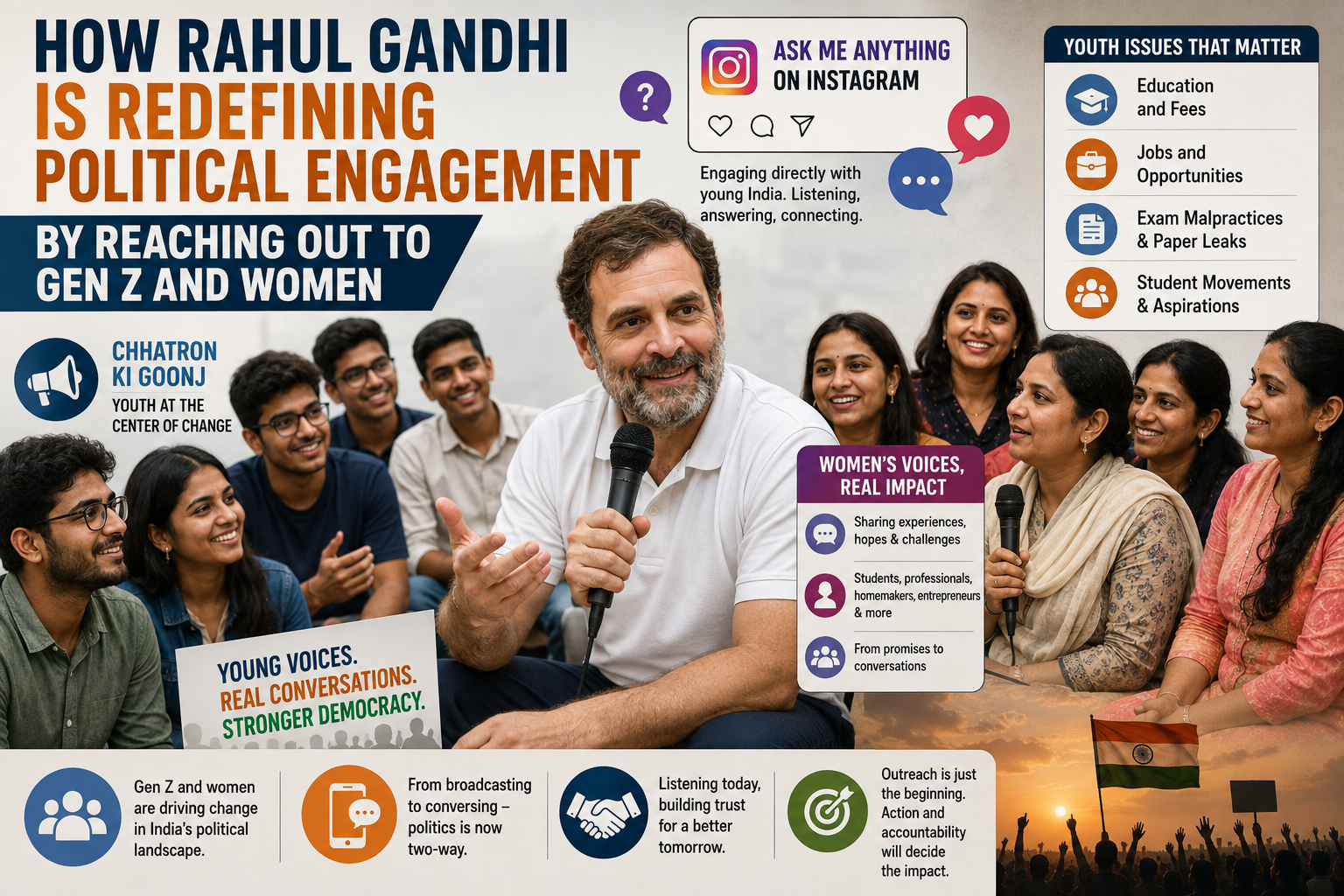
The times when politics was dominated by conventional methods of communication have long gone and the contemporary political communication process is significantly influenced by social media, direct interaction and engagement of citizens. Taking into account the fact that nowadays Generation Z and women become one of the key constituents of Indian politics, Rahul Gandhi’s recent attempts to reach out to both groups show the new approach to engaging voters and discussing political issues.
One of the most notable examples of Gandhi’s attempt to establish contact with the audience has been his recent engagement with Generation Z. In August 2026, Gandhi conducted “Ask Me Anything” session on Instagram where students and young people could raise various issues with him. Among the topics of discussion were such serious things as student movements and education as well as some entertaining issues of popular culture and humor.
However, the approach does not confine to social media. As Gandhi’s Chhatron Ki Goonj social media campaign demonstrates, the youth is now in the epicentre of politics and political campaigns with topics like costs of education, job creation opportunities, examinations malpractices and papers leakages receiving increasing prominence. His program in Prayagraj, for example, reflected how the political weight of the youth and their concerns with education and employment are increasing. Moreover, his campaign can be viewed as part of the larger effort of the Congress Party to engage the youth again.
Importantly, what makes this approach different is the transition from the mere attention to young voters to active engagement. Gen Z generation is used to interacting. The members of this generation do not passively consume information but rather comment on things, ask questions and give feedback. It allows political leaders to present themselves as people who are more communicative and engaged in dialogical interaction with their audience.
However, Gandhi’s social media interaction with the women of India is adding another facet to the emerging political strategy. In particular, Gandhi has recently asked the Indian women to talk about their experiences, hopes and difficulties. Such interaction is bringing many aspects of woman’s life into the political discourse.
Even more so when considering the diversity of women as it includes students, professional women, homemakers, entrepreneurs and other women from varied socio-economic backgrounds. The purpose of this outreach activity, therefore, is to shift the debate from the promises made by the candidates in election times to actual discussion through giving the women an opportunity to express their views.
Both the youth and the women play an equally important role in politics in that they are influential in shaping debates in public and community discourses and even in the elections. The youth have been increasingly influential in influencing political debates via social media, while the participation of women and their issues have become crucial for political campaigns in India. It appears that the outreach by Gandhi acknowledges the fact that future political engagement requires direct communication.
Nevertheless, this outreach campaign cannot ensure political success in itself. The interaction via social media and public discourse may bring visibility but the results of this outreach activity may be determined by how much the actions and policies are discussed. Just as much as authenticity and accountability are crucial for generation Z, the women can measure the effectiveness of this outreach based on actions taken.
But the changing attitude of Rahul Gandhi towards politics in some sense symbolizes the changing scenario of Indian politics itself. Slowly and steadily, the age-old process of political communication which used to go from stage to people has been transformed into a more dynamic process wherein the leader needs to not only talk, but also listen.
It yet needs to be seen whether this style of Rahul Gandhi will lead to electoral success. However, with digital interaction, student interaction and discussion based on women’s issues, Rahul Gandhi appears to indicate the beginning of a new trend in political engagement.