





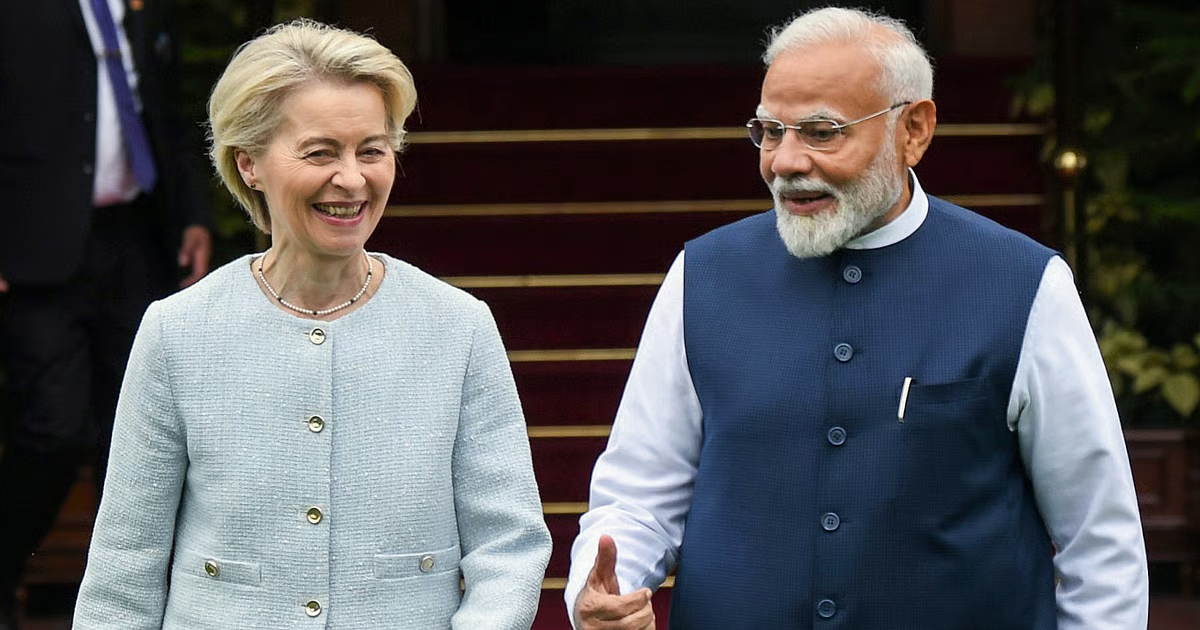
India and the European Union are on the brink of finalising a historical Free Trade Agreement, which has been labelled “The Mother of all Deals” by many officials, that would set the tone for a whole new era of international trade between two entities that would command a market of 2 billion consumers, a quarter of which is the global GDP.
European Commission President Ursula von der Leyen drew attention to the progress on the trade agreement during her World Economic Forum (WEF) address at Davos when she said, “There is certainly work to be done,” but both India and the EU are “on the cusp of starting a historic trade agreement.”
Why This FTA Is Being Called the ‘Mother of All Deals’
The proposed agreement would link two of the most dynamic and strategically significant economic regions in the world. It aims to establish:
- A market of roughly 2 billion people—a combined consumer and producer base that could significantly boost trade and investment flows.
- Economic coverage equivalent to about 25% of global GDP, underlining its potential global impact.
- Preferential access to all 27 EU member states under a unified framework, benefiting exporters and investors on both sides.
For India, the EU is a major trading partner, with bilateral goods trade already reaching high levels in recent years.
Long-Pending Talks Nearing a Breakthrough
Negotiations on an India-EU FTA began as far back as 2007 but stalled in 2013 due to differences over tariffs, market access and regulatory standards. Talks were revived in 2022, triggering renewed momentum toward a pact that could finally be agreed upon after nearly two decades of discussions.
Von der Leyen’s announcement at Davos, followed by her planned visit to India from January 25–27 as chief guest for Republic Day celebrations, reflects both sides’ desire to conclude the deal around the India-EU Summit on January 27.
Commerce and Industry Minister Piyush Goyal has also described the FTA as a transformative agreement for India, calling it the “mother of all deals” among India’s trade negotiations.
LONG-PENDING TALKS NEARING A BREAK
The trade talks for an India-EU FTA began as early as 2007 but halted in 2013 because of divergences in customs duties, market access, and regulatory principles. These trade talks resumed in 2022, giving rise to fresh momentum in forging a deal that could be reached after about two decades of talks.
“Von der Leyen’s January 16, 2023, announcement at the meeting of the World Economic Forum in Davos, coupled with her upcoming visit to India from January 25-27, where she would be the chief guest for the Republic Day celebrations, is a manifestation of the relative readiness of both the countries to finalize the agreement by January 27, the
Commerce and Industry Minister Piyush Goyal has also termed the FTA ‘a completely transformational agreement’ for India and referred to it as ‘the mother of all deals’ among the country’s trade agreements.
Potential Economic Impact
If finalised, the FTA could:
- Boost Indian exports by giving wider access to European markets, especially in goods and services.
- Enhance EU access to India’s fast-growing market, particularly in technology, pharmaceuticals, clean energy and advanced manufacturing sectors.
- Provide stronger legal predictability and market access for businesses on both sides, encouraging foreign direct investment (FDI) and innovation partnerships.
The deal is also seen as a strategic counterbalance amid shifting global trade dynamics, allowing both India and the EU to diversify supply chains and reduce overdependence on single-country markets.
A Trade Deal That Could Redefine Global Economic Partnerships
The India-EU free trade agreement, labelled as the “mother of all deals,” stands on the brink of conclusion after nearly 20 years of negotiations. With the potential to create a 2 billion-strong market accounting for roughly a quarter of global GDP, this pact could reshape global trade, amplify economic cooperation and strengthen strategic ties between India and Europe.
As both sides prepare to finalise the agreement around the January 27 India-EU Summit, businesses, investors and policymakers worldwide will be watching because once signed, this FTA could become one of the most influential trade frameworks of the 21st century.





More Stories
Top 10 sustainable companies in India 2026: IT firm at no. 2 sets benchmark in gender equality with the largest female tech workforce
India vs New Zealand, T20 World Cup 2026 Final: IND defeat NZ by 96 runs, wins third title
Samir Soni reacts as the internet calls Amitabh Bachchan the real villain of Baghban: finally, some redemption