






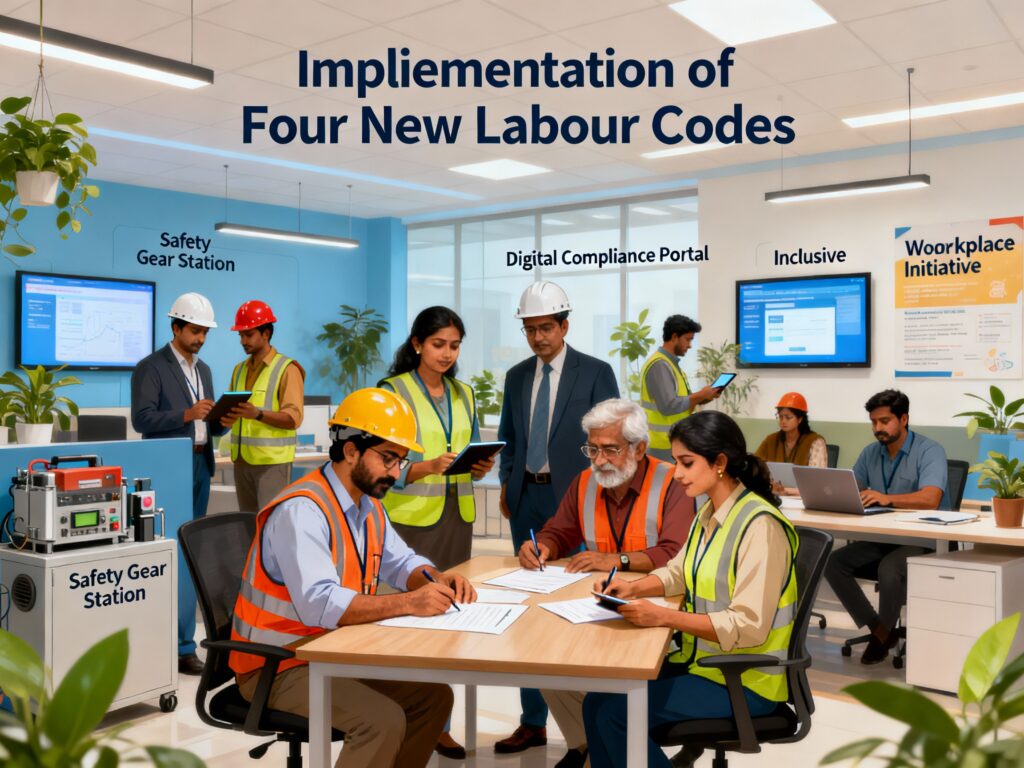
Landmark Reform: In a major reform, the Government of India has enforced four new labour codes, thereby replacing 29 existing central labour laws. Starting from 21 November 2025, this move is being termed as one of the biggest labour reforms since independence.
What are the four new labour codes?
The four codes now in force are:
- Code on Wages, 2019
- Industrial Relations Code (2020)
- Social Security Code, 2020
- Occupational Safety, Health and Working Conditions (OSHWC) Code 2020
The new laws are designed to simplify the fragmented labour framework in India and guarantee more welfare and benefits for workers.
Why This Reform Matters
Simplified Legislation: Consolidation of the 29 laws into four makes compliance easier for employers and employees.
Better Worker Protection: More workers, especially those working in gig economy jobs, contract, and informally employed, stand to benefit from social security, minimum wages, and safe working conditions.
Modern Workforce Ready: The codes represent a shift away from archaic labour laws – mostly from pre-independence times – aligning India’s rules with modern economic realities.
Key Changes & Benefits for Workers
The new codes brought in many significant changes, some of which are listed below:
Appointment Letters: Workers must now be given a formal offer or appointment letter, providing better transparency.
Universal Social Security: Gig workers, platform workers, migrant labourers, and contract staff shall fall under the ambit of social security schemes.
Minimum Wages: A national floor wage has been introduced in order to ensure that no worker earns below a particular minimum.
Health Check-ups: Those above a particular age are entitled to free annual medical check-ups, which will help with early detection of various health problems.
Women’s Safety: Women are legally allowed to work on night shifts with their consent; the working standards concerning their safety are strict.
Improved Safety: All institutions will be bound by improved safety regulations, making the places of work even safer.
Impact on Employers & Businesses
Simplified Compliance: There is now only one registration, one licence, and one electronic return for the employer to maintain, instead of multiple filings.
Flexible Industrial Relations: The threshold for layoff approval has been raised – companies with as many as 300 workers can conduct layoffs without prior government approval.
Guiding Inspectors: Nowadays, labour inspectors work much more as facilitators than just punitive enforcers, so the system is becoming more cooperative.
Mixed Reactions & Concerns
Industry support : This reform has been broadly welcomed by the business leaders, who feel that it will increase investment, simplify compliance, and modernise labour governance.
Union Criticism: A number of trade unions are wary – the changes, they say, will erode some protections that workers, particularly contract and fixed-term employees, enjoy.
Economic Experts Weigh In: Some economists believe the reform will pose short-term challenges to small firms but bring long-term benefits like better wages and stronger social security.
Reform Supporters: Economist Arvind Panagariya described these codes as the “mother of all reforms” that could help attract investment and spur job creation.
What’s Next
While the four Labour Codes are officially in force, many detailed rules and schemes are still being worked out. Some state governments need to notify the supporting regulations, and there will be ongoing stakeholder consultations to fine-tune the implementation. Ernst & Young.
If implemented effectively, these reforms can open up avenues towards a more inclusive, secure, and globally competitive labour ecosystem in India.






More Stories
Iran-Israel War News Live Updates: Smoke seen rising from the US embassy vicinity in Kuwait, claims report
India to protect its interests in trade deal with US: Piyush
All 7 On Board Air Ambulance Flying To Delhi Die In Crash In Jharkhand