





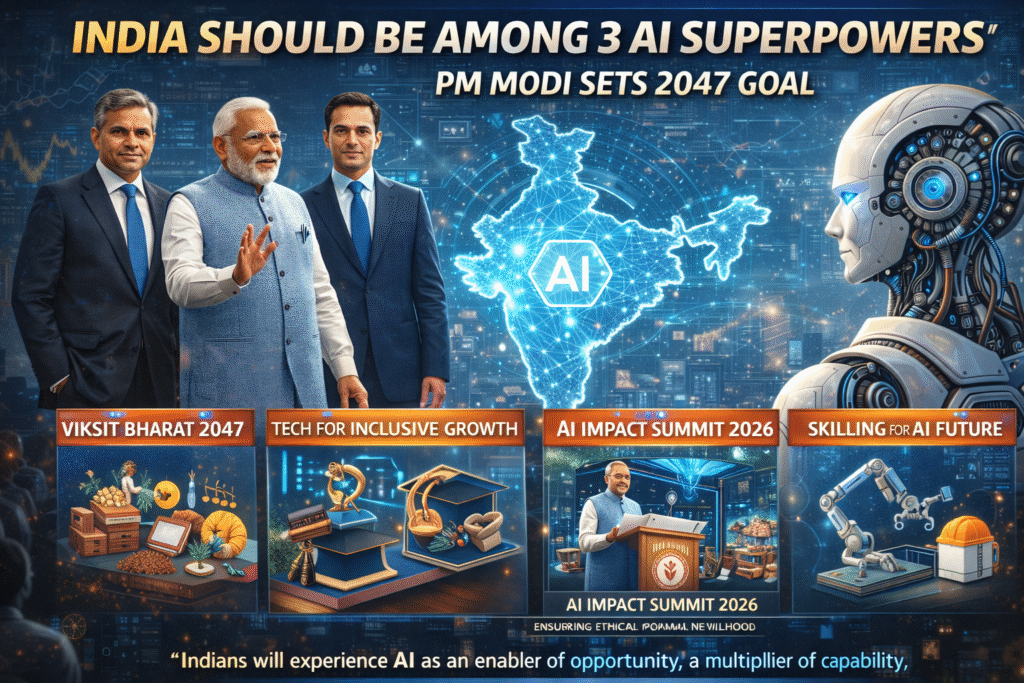
Our prime minister, Mr Narendra Modi ji, states that, “Indians will experience AI as an enabler of opportunity, a multiplier of capability, a servant of human dignity, not as a threat to their livelihood.” During the inauguration of the India AI Impact Expo at Bharat Mandapam in New Delhi, he posted a picture on social media. With two more ministers, Union ministers Ashwini Vaishnaw and Jitin Prasada. They move to make changes in the world, and with them us also taking a step towards the changes in our country.
India AI Impact Summit 2026 commenced in the national capital, marking the first time that a global convening of this scale on artificial intelligence is being organised in the Global South. He is a special interview with ANI’s text service, which underlined the guiding spirit of the summit under the umbrella ‘Sarvajan Hitay, Sarvajan Sukhaye’. He also makes a court of that well fear for all, happiness for all.
The head of state and the government meet together because of a summit. The Global technology leaders and industry stakeholders are both deliberating on the role of AI. Which is called advancing inclusive growth. This also strengthens public systems and enables sustainable development. In his interview, Prime Minister Modi outlined India’s vision for the new era, emphasising that artificial intelligence should drive global development while remaining firmly rooted in a human-centric approach.
A question arises in all the above was that India is hosting the AI Impact Summit 2026 for the first time anywhere in the Global South. The next thing was, The Motto of the Summit is “Sarvajan Hitay, Sarvajan Sukhaye” (Welfare for all, happiness of all). What’s the vision of this Summit? Also, please confome that why this motto? He said in his opinion, he stated that today, AI stands at a civilisational inflexion point. It can expand human capability in unprecedented ways, but it can also test existing social foundations if left unguided. That is why we have deliberately framed this Summit around Impact that ensures meaningful and equitable outcomes, not just innovation. It is clear.
The guiding spirit, ‘Sarvajan Hitay, Sarvajan Sukhaye’, reflects India’s civilisational philosophy. This technology’s end goals the results are ‘Welfare for All, Happiness of All’. Making our India, we can prove that. The meaning of technology is positive, but nowadays people make the meaning of usage of technology in a different way. They can’t understand the real benefit of technology nowadays; people have higher aims, but some have different thought with the technology. People can’t discuss about the technology; they only just started to use it.
AI systems draw upon knowledge and data generated across societies worldwide. Therefore, we want AI’s benefits to be diffused to everyone and not just hoarded by early adopters. Do you know where the first this ai is hosted? It is hosted in the Global South; India is creating a platform that amplifies underrepresented voices and development priorities. The multiple things are not issues for us: AI governance, inclusive datasets, climate applications, agricultural productivity, public health, and multilingual access. We are creating new creations and always doing different experiments. With the help of this Our vision is clear: AI must accelerate global development while remaining deeply human-centric. We are clear aim in life.
We have a multiplier of capability. Someone asked to Modi ji, you have always spoken about using technology for empowerment and development. How do you see AI’s role in Viksit Bharat 2047? He replied to them, AI represents a transformative opportunity in India’s journey towards Viksit Bharat 2047. Leveraging AI mindfully, with a strategic lens, helps address deep developmental challenges while creating entirely new economic opportunities, enabling inclusive growth, bridging the urban-rural divide and expanding access to opportunity.
He said in healthcare, AI is already delivering impact. We are seeing AI-based solutions addressing early detection of tuberculosis, diabetic retinopathy, epilepsy and many other ailments at primary and district health centres. Furthermore, he describes their thoughts by explaining to them, In education, AI-powered personalised learning platforms in Indian languages are helping students in rural and government schools receive customised academic support. In a very unique initiative, Amul is leveraging AI to reach 36 lakh women dairy farmers across thousands of villages, providing real-time guidance in Gujarati on cattle health and productivity, empowering grassroots women producers.
About the farmers and the agricultural field, he shared his opinion with them. In agriculture, the Bharat Vistaar initiative aims to integrate AI into crop advisory, Noil analytics and weather intelligence, helping farmers make better, localised decisions.
Even in heritage preservation, AI is enabling the digitisation and interpretation of ancient manuscripts, unlocking India’s civilisational knowledge systems. He is explaining there provice time also by saying, at a time when the world is worried about AI deepening divides, India is using it to dissolve divides. We are making it an efficient tool for delivering healthcare, education and economic opportunity to every village, every district, and every citizen. Because he is thinking about everyone. He is just to make our country’s conditions improve and develop a new, clean and clear nation. He does not want division of the country.
Also, thinking about his statement in the speech, I was thinking that, in the speech at AI Action Summit 2025 in Paris, you emphasised the bias and limitations of AI. From now and then, has the scenario changed? How do you see India addressing this issue? And I got my doubt cleared here in his speech. The concerns regarding bias and limitations in AI remain deeply relevant. As AI adoption accelerates, the risks also scale. AI systems can inadvertently perpetuate biases related to gender, language and socio-economic background. The AI Impact Summit 2026 is bringing together various stakeholders and creating global awareness on matters such as biases and limitations of AI. This is an issue that needs global cooperation. He is trying to overcome the situations.
For India, there are unique challenges and developments as well as opportunities. Our diversity – linguistic, cultural, regional – means that AI bias can manifest in ways that might not be obvious in Western contexts. An AI system trained primarily on English data or urban contexts may perform poorly for rural users or speakers of regional languages. Greater emphasis on AI development in regional languages, and growing research on fairness and bias in Indian academic institutions and tech companies.
By seeing this, the next question arises that India’s success in building low-cost Digital Public Infrastructure (DPI) like Aadhar and UPI is phenomenal. The convergence of DPI and AI could significantly improve public service delivery. What is India’s learning on this, which could help the Global South? Do you think by this side …. What is the decision India take? India’s Digital Public Infrastructure journey offers crucial and practical lessons for the Global South. The convergence of DPI and AI is the next frontier of inclusive development. Our success with Aadhaar, UPI and other digital public goods was not accidental. It stemmed from a few replicable principles. First, we built digital infrastructure as a public good, not a proprietary platform. This open and interoperable architecture allowed innovation to flourish on top of a common base layer. Second, we designed for scale and inclusion from day one. Our systems work for 1.4 billion people, irrespective of their socio-economic status, literacy level, region or language.
At the same time, we understand the importance of robust digital infrastructure, strong data privacy protections, thoughtful regulatory frameworks and AI literacy across society. Technology must serve every citizen, regardless of geography, gender or income. offers a scalable model for the Global South.
India is a powerhouse of engineering talent. We contribute a large tech workforce to the world. How could we further deepen this in the AI era, think this side. Is this for creating a new India? These developments are for the citizen. Our startups, research institutions and tech ecosystem can build AI solutions that enhance manufacturing, improve governance and generate new jobs. He is confident that our youth can build AI solutions for Indian realities, designed for farmers, MSMEs, women entrepreneurs and grassroots innovators. He remains committed to strengthening every effort by our talented youth to make AI a force multiplier for innovation and inclusion. The Union Budget 2026-27 reinforces this vision. It expands support for data centres and cloud infrastructure, strengthening domestic compute capacity. Under the India AI framework, startups and research institutions are being supported with access to high-performance AI compute resources. Continued push for semiconductor manufacturing, electronics PLI, AI Centres of Excellence and digital skilling strengthens both hardware and human capital foundations. He is saying that he is not just showing talent. India has a vibrant IT sector contributing significantly to our service exports.
Now, just say about How do you see AI impacting our IT sector? And what are the steps the Government is taking to bolster our IT sector? Is there any solution to this? What is going on with the next step that our pm thinks about the next step. The PM says about he discusses with the public, India’s IT sector has been the backbone of our services exports and a key driver of economic growth. AI presents both a tremendous opportunity and a challenge for this sector. AI market projections show India’s IT sector could reach $400 billion by 2030, driven by new waves of AI-enabled outsourcing and domain-specific automation. The fundamental shift is that AI isn’t replacing the IT sector. It is transforming it. While general-purpose AI tools have become widespread, enterprise-grade AI adoption is still concentrated in specific sectors, and incumbent IT firms continue to play crucial roles in solving complex business problems.
To enable a strong Indian AI ecosystem, the government has responded with a comprehensive strategy centred on the India AI Mission. We’ve already exceeded our initial target of GPUs, and we are committed to doing more to provide affordable access to world-class AI infrastructure for startups and enterprises.
Technology is a powerful tool, but it is only a force multiplier for human intent. It is up to us to ensure that it becomes a force for good. While AI may enhance human capabilities, the ultimate responsibility for decision-making must always remain with human beings. Around the world, societies are debating how AI should be used and governed. India is helping shape this conversation by showing that strong safeguards can coexist with continued innovation. We need a global compact on AI, built upon certain fundamental principles. The government launches so many Indian AI Safety Institutes in January 2025, creating a dedicated mechanism to promote the ethical, safe, and responsible deployment of AI systems. This software has been created for the ethical, responsible development and safe.
In response, India notified rules requiring watermarking of AI-generated content and the removal of harmful synthetic media. Shipping to ensure safety and accountability across borders, similarly, the world must work towards common principles and standards in AI.PM Modi says, “I understand the concern of our youth about AI-driven disruptions in the job market. Preparation is the best antidote to fear. That is why we have been investing in skilling and re-skilling our people for an AI-driven future. The Government has launched one of the most ambitious skilling initiatives in the world. We’re not approaching this as a future problem, but we’re treating it as a present imperative. I view AI as a force-multiplier which will further help us push the boundaries of what we thought possible. It will help doctors, teachers, and lawyers to reach out to and help a larger group of people.
India is already well equipped to adapt to this change. In the Stanford Global AI Vibrancy Index 2025, India ranked 3rd, reflecting strong growth in AI R&D, talent, and economy. AI-powered public services will be studied globally as benchmarks for efficient, equitable governance. And most importantly, every Indian will experience AI as an enabler of opportunity, a multiplier of capability, and a servant of human dignity, not as a threat to their livelihood or an instrument of control. There is so much use of AI; these days are so fast and less time-consuming. This is the superpowers of the AI. In this generation. The strongest features are be there nowadays and it creates bigger and bigger things in a few seconds.



More Stories
Solar stocks crash: Waaree Energies slumps over 14%, Premier Energies down 12% as US tariffs bite
Sam Altman plays down AI water-use claims, says energy is the real issue
‘Safety-first’ mindset accelerates transition of high-end technologies in mass-market vehicles: Techarc report