





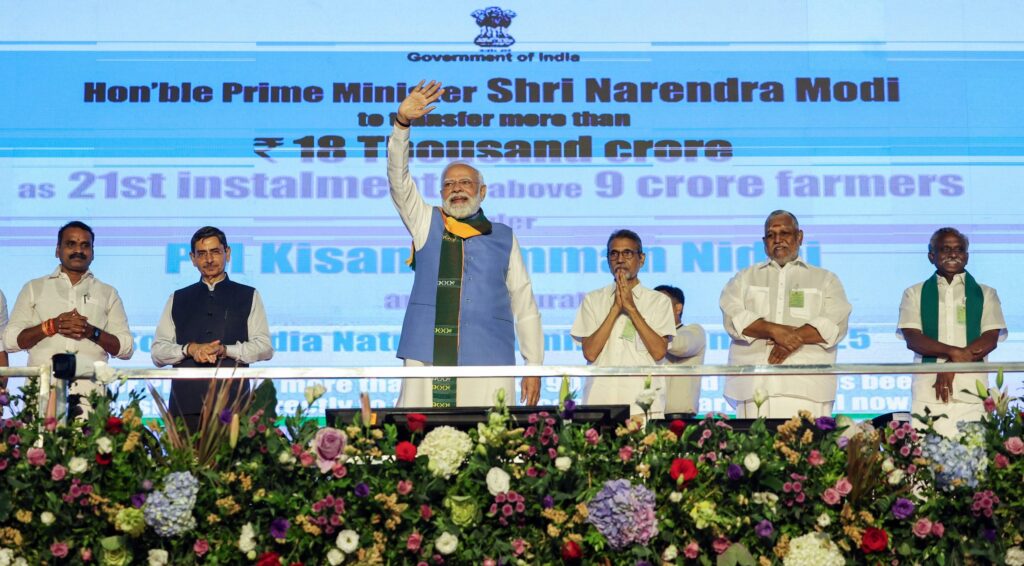
Prime Minister Shri Narendra Modi launched the South India Natural Farming Summit 2025 in Coimbatore, Tamil Nadu, in an effort to promote sustainable and chemical-free farming. Village honoured his nature; he started by paying respects to Lord Murugan of Marudhamalai. The PM called Coimbatore a “city of culture, compassion, and creativity,” a city that is famous for entrepreneurship and the textile industry as well as proud of the former MP of the constituency, Shri C.P. Radhakrishnan, now the Vice President of India.
Natural Farming was dear to PM Modi
PM Modi referred to natural farming as a subject “deeply close to his heart” and sent his greetings to farmers from Tamil Nadu and commended the attendance of agricultural scientists, innovators, young entrepreneurs and the industry at large. He reiterated the progress of India on its way to becoming the world capital of natural farming through biodiversity acceleration as well as a young generation that is increasingly seeing agriculture as modern and scalable.
Eleven Years of Agricultural Transformation
PM Modi mentioned the pace of progress in Indian agriculture over more than a decade:
- The exports of agricultural products have almost doubled, which has strengthened India’s position in the global market.
- This year, over ₹10 lakh crore has been released under the Kisan Credit Card (KCC) programme.
- Farmers with KCC’s assistance have benefitted as livestock and fisheries were added over the past 7 years.
GST reductions on bio-fertilisers make natural inputs more accessible to farmers.
He also announced that the 21st instalment of PM-Kisan Samman Nidhi would be disbursed to farmers and that ₹18,000 crore would be direct transfers to farmers. Over 4 lakh crore has been transferred to the bank accounts of small farmers to assist in typical agricultural expenses.
Need for Natural Farming in 21st-Century Farming
The Prime Minister emphasised concerns around chemicals rising in farming and that chemicals and pesticides cost farmers and are degrading soil health, reducing moisture, and increasing costs of production. He stressed the answer is in crop diversification and agricultural and natural farming.
He emphasised the fact that natural farming:
- Restores soil fertility
- Increases the nutritional value of crops
- Lowers farming expenses
- Creates climate resilience
- Preserves biodiversity for oncoming generations
PM Modi described natural farming as both a vision and a requirement for India’s future.
National Mission on Natural Farming Takes Off
The Prime Minister established that there has been a positive response to the National Mission on Natural Farming, which he launched the previous year, and has since connected lakhs of farmers. In Tamil Nadu alone, about 35,000 hectares of land are now using organic and natural farming.
He stated that he was pleased to see South Indian farmers increasingly using traditional systems such as Panchagavya, Jeevamrit, Beejamrit, and mulching, which are traditional systems for improving soil health while relying less on chemical inputs.
Encouraging Millets through Agroecology
Noting the significance of Shree Anna (millets), Prime Minister Modi remarked that the introduction of Shree Anna prepared and served as Thenum Thinai Maavum to Lord Murugan reiterates the historical context of Shree Anna in South India. Varieties of millets—Kambu, Samai, Ragi, Sajja, and Jonna—have been consumed for centuries.
PM Modi acknowledged that the government will promote millets globally and noted that the significant acceptance of millets globally will occur through chemical-free farming.
South India: A Model for Multi-Crop and Integrated Farming
Reiterating the importance of diversifying agriculture, PM Modi explained that South India has long demonstrated the success of multi-crop farming instead of monoculture. The practices observed in hilly regions of Kerala and Karnataka demonstrate layers of cultivation — combinations of coconut, areca nut, and various fruits and spices coexisting, so much so that small agricultural farms are productive and sustainable.
PM Modi encouraged states to emulate these models of agricultural development throughout the nation, citing these methods as part of the natural farming paradigm, which is the fundamental ideal behind them.
Encouraging Millets through Agroecology
Noting the significance of Shree Anna (millets), Prime Minister Modi remarked that the introduction of Shree Anna prepared and served as Thenum Thinai Maavum to Lord Murugan reiterates the historical context of Shree Anna in South India. Varieties of millets—Kambu, Samai, Ragi, Sajja, and Jonna—have been consumed for centuries.
PM Modi acknowledged that the government will promote millets globally and noted that the significant acceptance of millets globally will occur through chemical-free farming.
South India: A Model for Multi-Crop and Integrated Farming
Reiterating the importance of diversifying agriculture, PM Modi explained that South India has long demonstrated the success of multi-crop farming instead of monoculture. The practices observed in hilly regions of Kerala and Karnataka demonstrate layers of cultivation — combinations of coconut, areca nut, and various fruits and spices coexisting, so much so that small agricultural farms are productive and sustainable.
PM Modi encouraged states to emulate these models of agricultural development throughout the nation, citing these methods as part of the natural farming paradigm, which is the fundamental ideal behind them.
Call for a Science-Backed Natural Farming Movement
In order to create an agricultural ecosystem that is suitable for the future, PM Modi appealed to farmers to initiate “one acre, one season” natural farming to leverage the results. He asked scientists and institutions to include natural farming in their academic curriculum and to regard farmers’ fields as living laboratories.
“Our goal should be to make natural farming a completely science-backed movement,” he said.
Reinforcing FPOs and Market Linkages
The Prime Minister noted the importance of the state governments and Farmer Producer Organisations (FPOs). With 10,000 FPOs established recently, India is establishing clusters of smallholder farmers that have facilities for cleaning, processing, and packaging, as well as digital linkages to e-NAM. He stated that the combination of ancient knowledge, scientific innovations, and government support will leave the farmer they serve empowered, while also protecting the health of the planet.
PM Modi stated that he hoped the South India Natural Farming Summit 2025 would be a point of no return for India’s transition to a sustainable agricultural model in India, building new ideas, regional leadership, and accelerating India’s transition to sustainable chemical-free farming.
Important individuals, such as the Governor of Tamil Nadu, Shri R.N. Ravi, and Union Minister Dr L. Murugan, were in attendance at the event.
About the Summit
The South India Natural Farming Summit 2025 is being organised by the Tamil Nadu Natural Farming Stakeholders Forum from the period of November 19-21, 2025. The aim of the summit is to:
- Mobilize support for natural and regenerative farming
- Exhibit innovations in organic inputs and agro-processing
- Facilitate market linkages for FPOs and rural entrepreneurs
- Encourage climate-smart, sustainable agricultural models
There are more than 50,000 individuals in attendance, including farmers, scientists, startups, and practitioners of natural farming from Tamil Nadu, Kerala, Karnataka, Andhra Pradesh, Telangana, and Puducherry.





More Stories
CTET February 2026 Re-Exams Set For Two Centres In Bihar
Solar stocks crash: Waaree Energies slumps over 14%, Premier Energies down 12% as US tariffs bite
UP Board exams: principal solver held