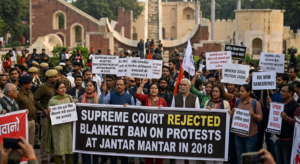


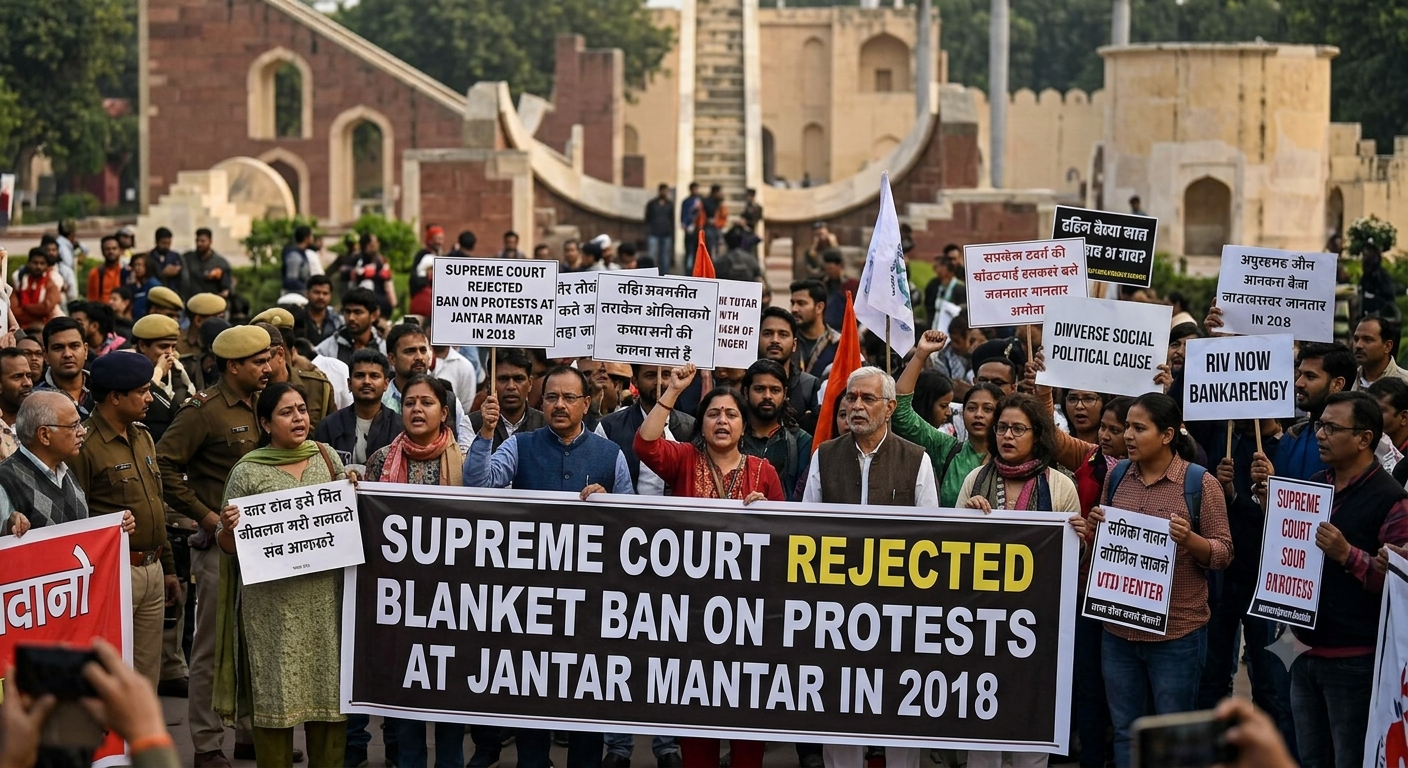
However, the apex court of India, the Supreme Court, in 2018, dismissed the idea of banning any demonstration in the Jantar Mantar and Boat Club area of New Delhi as this would be against the democratic principle of having public demonstrations in a country. The case was regarding the balance between the rights of citizens to speak out and the maintenance of public order and convenience of citizens living nearby.
For decades, Jantar Mantar is considered to be one of the important places for public protests as people gather here to highlight their grievances related to social, political and economic matters of the country. But the issue related to noise, traffic pollution and disturbances to residents living nearby gave rise to restriction of any protest in the area.
National Green Tribunal (NGT) had put a ban on any demonstration or sit-in in the area of Jantar Mantar in October 2017 due to concerns of noise pollution, environment and difficulties that the local residents were facing.
A Bench of Justices A.K. Sikri and Ashok Bhushan, on July 23, 2018, found a total ban on demonstrations in Jantar Mantar and the Boat Club area to be unacceptable. This decision was made in the case of “Mazdoor Kisan Shakti Sangathan v. Union of India”. The court recognized peaceful protest as a fundamental right enshrined in the articles 19(1)(a) and 19(1)(b) of the constitution, providing freedom of speech and expression and the right to peaceful assembly respectively.
Nevertheless, the court stressed that the right to protest is not an unrestricted right to conduct demonstrations anywhere and at any time. The court stressed the need to regulate demonstrations through proper guidelines, in particular, in relation to the number of demonstrators, the location of demonstrations, and avoiding inconveniences for citizens.
Thus, the ruling pointed to the need for balancing two crucial values: the right of citizens to express their dissatisfaction and the right of people to a quiet life.
The ruling of 2018 continues to be a significant one when it comes to matters of assembly and democratic freedom within India. In its decision, it stated that while restrictions may be needed in some cases, a complete ban cannot take the place of regulations.