






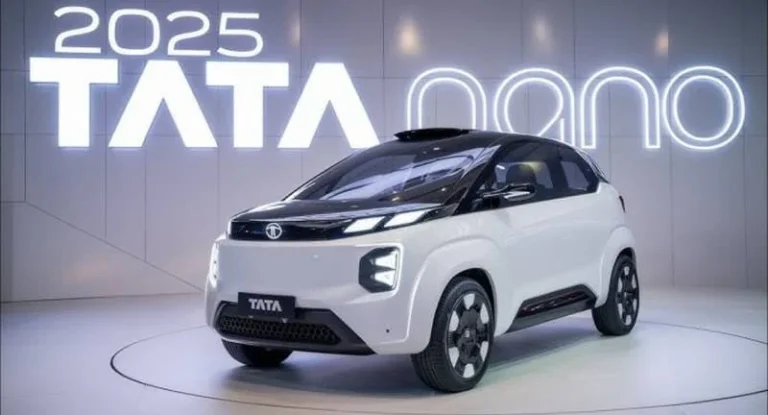
The Tata Nano EV is an all-electric avatar of the iconic city car, geared to bring affordable, clean mobility once again to the doors of urban and semi-urban India. Standing on the mantle of the original Tata Nano, this upcoming electric vehicle brings back the “people’s car” ideal into the modern world that talks of sustainability, convenience, and minimum running costs.
Nano EV Matters: How Can It Fill Gaps in Indian Urban Mobility?
Compact size, ideal for cities
With proportions similar to the original Nano, the Nano EV remains a tight-footprint hatchback—perfect for congested streets, narrow lanes, and tight parking spots common in Indian cities.
Accessible electric mobility
While most of the EVs aim to have higher price targets, Nano EV tries to democratise driving electrically. Its smaller size, simpler powertrain, and anticipated low-cost positioning may open EV ownership to a greater portion of society.
Lower running & maintenance costs
Nano EV, with an electric powertrain and efficient battery use, has been designed for a low cost per kilometre, thus being attractive for day-to-day commuting, short runs, and city-based errands.
What to Expect—Key Features & Speculations
While still unconfirmed officially, a number of recent reports give an idea of what Nano EV could be:
Feature / Spec\tExpected / Reported Detail
Battery & Range: 15–28 kWh lithium-ion or LFP battery pack; real-world range from ~150 km to 250 km depending on the variant
Ideal Use Case: Mainly commuting within the city and doing urban travel; thus, suitable for first-time car buyers, women drivers, and small families.
Charging Options: Home AC charging overnight; possibly supporting fast charging to top it up more quickly.
Design & Comfort: Carries the same compact body but with a facelift; new headlamps, a revised grille, and probably an updated interior for increased comfort compared to that of the original Nano.
Affordability Objective: Positioned as an affordable EV alternative, thus offering electric mobility to low- and middle-income buyers.
The Road So Far: Nano’s History & EV Aspirations
Launched with the vision of a ‘low-cost people’s car’, the original Tata Nano thus met its demise around 2018–2019 amidst evolving safety norms, changing customer expectations, and stigma around the “cheap car” label.
Over the years, several attempts and rumors have popped up to revive the Nano in electric form. Various early prototypes and retrofit projects (such as through a collaboration with an engineering firm) were spotted — though none reached mass-market production.
With increasing EV adoption in India, expanding charging infrastructure, and increasing focus on affordability in the EV segment, conditions are now more favourable than ever for a compact EV like the Nano EV to make a successful comeback.
Why Nano EV Could Resonate with Indian Buyers
- The ease of navigating through crowded cities or narrow lanes is facilitated.
- Lower running costs compared to petrol/diesel cars; savings of thousands each month in fuel are possible.
- Ideal for first-time car owners, be it small families, young professionals, or daily commuters who want to upgrade from two-wheelers at an affordable price.
- Environmentally friendlier: zero tailpipe emissions, lower carbon footprint, and reduced noise pollution.
What Is Not Clear (Challenges & Questions)
- Official confirmation & launch timeline: Although many sources indicate its launch anytime soon, there is no concrete official announcement from the company’s side yet.
- Real-world range & battery longevity: With most cheap EVs, the claimed range often doesn’t quite match what one would see in real-world driving. Battery durability in years to come remains to be seen.
- Safety & build quality: Given the issues that surrounded the original Nano – safety concerns and lightened construction among them – the EV version will need to meet current crash and safety norms if it’s to gain consumer trust.
- Charging infrastructure & resale value: Affordable EVs need widespread charging access; long-term resale value depends upon how well the batteries age.
Nano EV = A Promising Revival if Executed Right The Tata Nano EV is more than just a sentimental comeback; it may very well be a game-changer in the realm of affordable electric mobility in India. If delivered with realistic specifications, reliable build quality, and a price that sticks to the “people’s car” ethos, Nano EV has the potential to democratise EV ownership and offer a practical, city-friendly alternative to both two-wheelers and expensive EVs. For the time being, this remains a hope, but one which could reshape urban mobility for middle-class Indians.






More Stories
Solar stocks crash: Waaree Energies slumps over 14%, Premier Energies down 12% as US tariffs bite
Sam Altman plays down AI water-use claims, says energy is the real issue
‘Safety-first’ mindset accelerates transition of high-end technologies in mass-market vehicles: Techarc report