






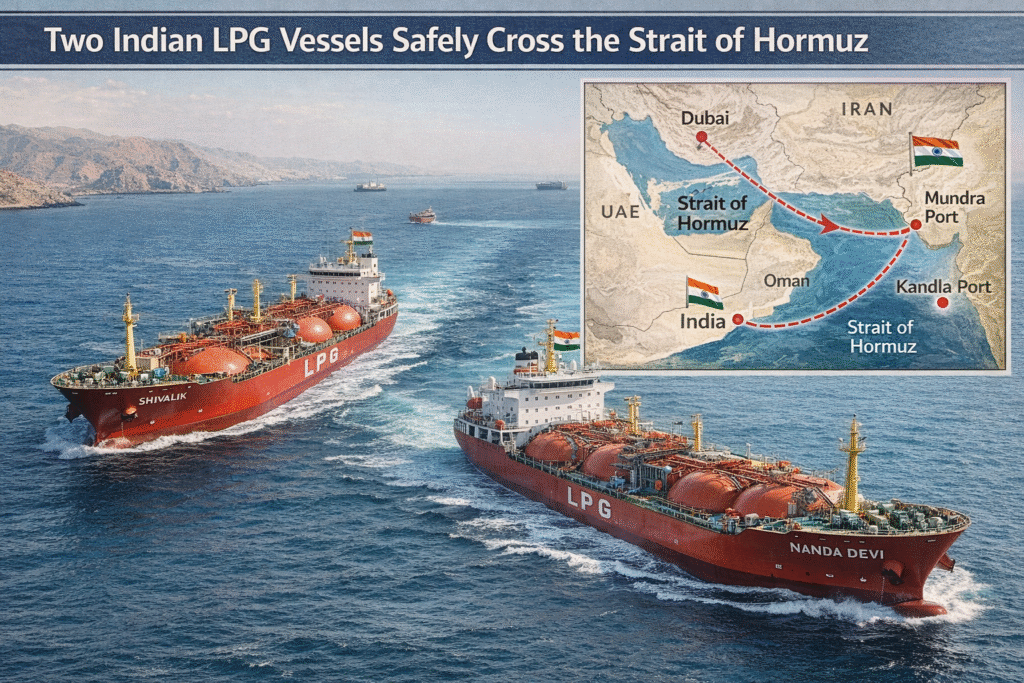
Shivalik is expected to reach Mundra Port on March 16, while Nanda Devi is expected to reach Kandla Port on March 17. Two liquefied petroleum gas (LPG) carriers, Shivalik and Nanda Devi, owned by the Shipping Corporation of India, have crossed the Strait of Hormuz and are headed to India, Rajesh Kumar Sinha, Special Secretary at the Ministry of Shipping and Waterways, told reporters at an inter-ministerial briefing here Friday (March 14, 2026).
Mr Sinha stated, Of the 24 vessels with an Indian flag operating in the Persian Gulf, LPG carriers Shivalik and Nanda Devi crossed the Strait of Hormuz early this morning safely and are headed to India.
The senior bureaucrat noted that the two carriers contain roughly 46,000 metric tonnes of cooking gas each, bringing the combined quantity to 92,712 metric tonnes. He noted that Shivalik will likely dock at Mundra Port by March 16, while Nanda Devi is set to reach Kandla Port on March 17.
Ships are very carefully leading so many issues can arise. Merchant ship tracking websites were periodically updating the locations of the two ships, indicating the ships had their Automatic Identification Systems (AIS) signals on. Since the conflict began, ships passing through the Strait of Hormuz have sometimes turned off their AIS and carried out a “dark transit” at night to avoid being detected or attacked. However, Nanda Devi crossed the strait during daylight.
Which means the regular updates are necessary, and after seeing the conflicts, we understand this. The ships must be overloaded sometimes. But it will be managed by the people. The ships are travelling after fully completely check-up. Following the outbreak of the conflict, some ships travelling through the Strait of Hormuz have turned off their AIS and made a “dark transit” at night to reduce the risk of detection or attack, while Nanda Devi passed through the strait during the day.
The information comes that about this on the orders from above. They said the two safe SCI ship crossings have occurred two days after Prime Minister Narendra Modi spoke to Iranian President Masoud Pezeshkian and raised the issue of unhindered transit of ships carrying oil and gas. The delay was up to the seed of the ship. The total of 22 vessels comes from the research after seeing this case.
According to Mr Sinha, following the exit of the two vessels, 22 ships with 611 crew members are currently waiting in the western part of the Strait. Of these, six vessels are carrying LPG, one tanker contains natural gas, four are loaded with crude oil and one is transporting chemical products. Together, these constitute the energy-based vessels. Of the remainder, three are container ships, one is a dredger, one is an emptying ballast, two are bulk carriers, and three are dry docks. The ships that are headed for repair and maintenance.
Together, these constitute the energy-based vessels. Of the remainder, three are container ships, one is a dredger, one is an emptying ballast, two are bulk carriers, and three are dry dock ships that are headed for repair and maintenance. The ships are moving according to the position of the flow and how it turns. The range and speed are controlled according to them. Continuous work is achieving high things.
The senior official had said on Thursday that Africa-bound Jag Prakash had exited the eastern part of the Strait, with three more vessels still operating in the region. The Special Secretary emphasised that the Ministry has instructed ports to provide priority berthing to LPG carriers to maintain uninterrupted energy supplies. He also noted that six vessels arriving from outside the Gulf area in the last three days have already received this provision.
India operates around twelve LPG carriers under its national flag, capable of transporting about 7 lakh tonnes of cargo. However, the country imports nearly 200 lakh tonnes of LPG annually, with most shipments carried by foreign-flagged vessels chartered by major oil firms.
About this issue, the government is also putting their point of view. The government has indicated a more than 30% increase in domestic LPG production, which amounts to roughly 10% of India’s LPG consumption on a day to day basis.
With the Persian Gulf out of bounds, India will need to find alternative sources from where these vessels can bring in LPG. Many ships, including SCI’s Sahyadri, are drifting off the coast of India waiting for orders. India’s oil companies signed a one-year contract to import 2.2 million tonnes of LPG from the U.S. Gulf Coast in 2026.
This constitutes nearly 10% of the country’s total yearly imports. The U.S. is the number one exporter of LPG in the world, with some 60 million tonnes of annual exports. Canada, the UAE and Qatar are a far second, third and fourth, respectively.
While contracts with the United States are in progress, the round-trip shipping time is estimated at about two months. Meanwhile, Nigeria, Malaysia, and Singapore are being explored as additional, though smaller, supply options. The U.S. may well be the biggest alternative source of LPG imports, but long voyage durations will pose a challenge for India, which is among the world’s largest importers of LPG.
The improvements are going on, and the changes are made daily according to new updates. The import and export are going on not even a single transaction is in the waiting. Millions and so many tons are being exported, and regular exchanges are going on. The ships are moving daily.





More Stories
US KC-135 Military Aircraft Crashes in Iraq During Operation Epic Fury, CENTCOM Confirms
Parliament Budget Session 2026 Live Updates: Oppn’s no-trust motion against Speaker Om Birla defeated
How much gold can Indians bring from Dubai as the West Asia war sparks a gold rush?