





Washington/Damascus: The U.S. military launched a massive retaliatory attack against
Islamic State (ISIS) in central Syria in response to an attack that killed U.S. personnel in the
previous week. The operation was codenamed Operation Hawkeye Strike and hit dozens of
IS locations, such as weapons caches and IS fighters.
This particular offensive occurred after an **ambush on December 13 near Palmyra, where
two U.S. Army members as well as an interpreter were killed, along with several others being
wounded in an attack that seemed to have been conducted by an ISIS-related attacker.
What the Retaliatory Strikes Involved
As stated by U.S. and coalition authorities:
● These airstrikes targeted more than 70 ISIS facilities in central Syria. These facilities
were believed to be infrastructure, weaponry storage, and operational centres of the
terror group ISIS.
● The combination of air and ground forces used consisted of fighter jets (F-15, A-10),
Apache attack helicopters, F-16 aircraft used by allied forces, and HIMARS rocket
artillery systems.
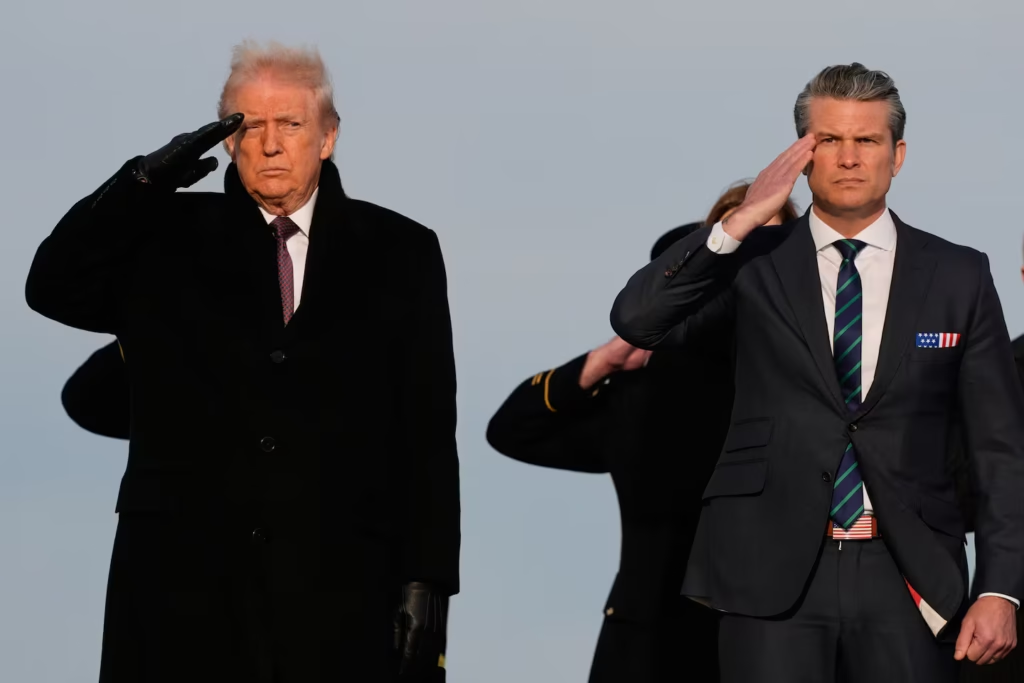
● The US Defence Secretary Pete Hegseth, while addressing the offensive assault,
termed it as “not the beginning of a war – but a declaration of vengeance. Hegseth
underlined that the assault was a direct reaction to the killing of US personnel.
● The United States employed more than 100 precision-guided munitions in this
strike.
The operation satisfied a promise made by U.S. President Donald Trump in response to the
“attack from Syria” with “very serious retaliation”, although the Syrian government, led by a
new administration after the removal of Assad, supported the U.S. against ISIS militants.
Why the Strikes Were Ordered
The strikes come on the heels of the ambush attack in Palmyra that resulted in the death of
two U.S. soldiers, who belonged to the Iowa National Guard, and a civilian interpreter.
According to reports, the assailant, who was later eliminated, attacked a U.S. and Syrian
military convoy. The two U.S. military fatalities also marked the first U.S. combat death in
Syria this year, although they highlighted the threat that still exists courtesy of ISIS remnants
despite the fact that the territorial caliphate has fallen.
The U.S. has its own 1,000 troops deployed in Syria as it continues its operations against
former ISIS strongholds in coordination with Syrian partners for whom eradicating safe
havens for the organisation is a priority.
Regional and Strategic Implications
● The military operation demonstrates the U.S.’s continued involvement in the region
against terrorism, even as ISIS maintains its insurgency despite having ceded
territorial control.
● The cooperation that has been received from the present government of Syria, which
is itself a coalition including members from the opposition, implies that there is
commonness against the radical factions.
● The military intervention also carries a strong deterrent message, as U.S. leaders
make a strong statement that attacks against U.S. forces will be met with strong
military actions targeted at weakening those militants.
Conclusion
The major U.S. retaliatory attacks in Syria represent one of the most prominent counter-ISIS
missions in the past few months as a result of the death of American troops as well as an
interpreter. Through attacks on more than 70 sites associated with ISIS infrastructure as well
as fighters, Operation Hawkeye Strike is part of an attempt to reduce ISIS operational
capabilities as a warning message against potential future attacks on American troops.
Although officials describe the attack as part of concerted retaliation action rather than the
start of another phase of the war, such bombing campaigns serve to confirm that the strategy
of the United States remains centred on countering terrorism in the area. The combined
effort involving planes from allies and cooperation with Syria also makes it clear that ever-
shifting alliances and terrorist groups remain important factors in military involvement in
Syria. As the developments emerge, one thing that experts will monitor is how these strikes
impact the capabilities of ISIS, as well as the measures that might be put forward in an
attempt to preclude future attacks on the coalition troops.





More Stories
Samir Soni reacts as the internet calls Amitabh Bachchan the real villain of Baghban: finally, some redemption
Blinkit CEO Deepinder Goyal Steps Down; Albinder Dhindsa Appointed to Replace Him—What It Means to Blinkit
ICC Dismisses Bangladesh’s Request for T20 World Cup Venue Change: Here’s What Went Down