






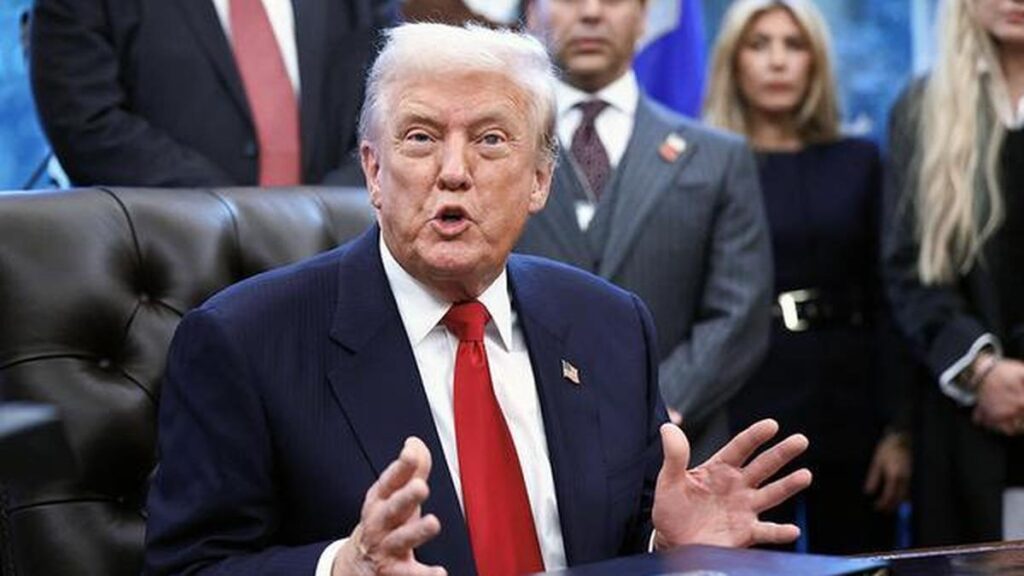
The U.S. Supreme Court is currently hearing a case that may determine whether President Donald Trump can impose tariffs on certain products of as much as 500% for certain foreign nations, including China and India. The decision will likely have broad-ranging repercussions, both economically and geopolitically, as evidenced by the immediate reaction in the financial markets globally, including in India.
The central issue before the court today is whether a president has the unilateral authority to impose import tariffs at such extreme levels as 500%, or if the U.S. Congress must provide more explicit authority for implementing these tariffs. The U.S. Supreme Court’s ruling in the case will shape future trade relations, influence investors in determining how to allocate capital, and impact economic ties between the U.S. and its trading partners.
In a Tariff Proposal Background
Donald Trump’s administration announced in late 2025 that they would be looking to impose tariffs as high as 500% on select imported goods from countries the administration believes benefit from unfair advantages through trade imbalances. Each product included on the list varies but will generally protect domestic manufacturing and counter perceived “unfair trade practices”.
In contrast, opponents of the proposed tariff increase argue that:
By creating higher tariffs, it would make it difficult for foreign countries to do business with the United States. It would also cause those affected countries to retaliate against the U.S. by imposing their own tariffs.
By creating higher tariffs, the cost of products that rely on imports will increase for American consumers.
By having higher tariffs, consumers will be subjected to increased prices for products, which will result in increased inflationary pressure in the consumer market.
While proponents of this tariff proposal say that tariffs are an effective way of providing protection against foreign competition and a way to reduce the trade deficit, there has been a debate over the legality of imposing these tariffs without the explicit consent of Congress.
The Supreme Court will consider whether or not the President’s actions with respect to tariffs on imports are unconstitutional or whether they fall under the Trade Expansion Act and the International Emergency Economic Powers Act (IEEPA), both of which have been enacted for many years.
The Supreme Court will also likely consider what limits there are on the President’s power to impose unilateral tariffs. If the President were to impose a tariff of 500% on an imported product, it would create a new precedent in trade law and thus require the Court to set limits on the extent to which the President can exercise the executive power to impose tariffs.
Additionally, the Supreme Court’s decision in this case will have implications for the U.S.’s compliance with WTO rules and may give rise to disputes at the international level concerning the President’s unilateral tariff imposition and/or retaliatory tariffs that were placed upon the U.S. products as a result of the imposition of tariffs on imports.
Investor sentiment and reactions from the market after the Supreme Court case’s uncertainty have been seen in the stock market, as well as through movements in currency values.
In stock markets, USA stock markets have seen much volatility due to fears over tariffs on imported goods, especially technology and consumer goods companies.
Indian stock markets have shown early pressure from their investors weighing the potential impact of increased tariffs from the US on Indian exports. In addition to steel and textiles, drugs and pharmaceuticals are significant contributing sectors to these exports.
As a result of this fear of trade disruption between the US and India, the Indian rupee has weakened slightly compared to the US dollar; however, this is a general fear-based response to a short-term issue.
Analysts warn that while immediate reactions from investors and the market can be symptom-related, ultimately the Supreme Court’s decision will determine global trade flow and how investment strategies will operate longer term.
The affirmation of expansive tariff authority will further incentivize other countries to pass similar laws; thus, the potential for an escalation of worldwide trade protectionism is likely. In that case, the critics of this scenario have warned of the following negative impacts:
- Retaliatory tariffs from impacted countries;
- Destruction of export-based economies, as in the case of India’s manufacturing and services;
- Overall reduction of trade volumes will result in a deceleration of global economic expansion.
- Alternatively, should there be an adverse ruling with respect to the executive’s ability to impose tariffs, this ruling may:
- Reinforce multilateral trade practices;
- Provide a degree of certainty for exporters and investors;
- Encourage multilateral agreements to resolve trade imbalances.
As such, diplomats and trade ministers worldwide are paying close attention to the developments of the current case, as Washington has a significant effect on establishing international trade practices.
What Happens Next
1. Timeline of the Court’s Verdict
The Court will likely release their final verdict in the coming weeks while the hearing process is ongoing; this decision may drastically affect U.S. trade law and the limits of executive authority over international trade agreements.
2. Trade Partners’ Reactions
As multiple countries, such as India, China, the European Union, etc., will have different strategies laid out based upon how the ruling is interpreted, they are preparing for either negotiations or litigation through WTO channels depending on what happens next once the ruling has been made.
3. Adjusting Policies
Many industries and governments will proactively adjust their supply chain strategies, tariffs, and other export strategies based upon what the Court finally rules as it relates to contract decisions and investment prioritisation.
How the USSC Ruling May Change US Trade Policy
The case that the US Supreme Court will hear regarding President Trump’s proposed ability to impose a 500% tariff is an extremely crucial case for how the US handles trade policy, and will affect constitutional power between Congress and the executive branch, as well as global economy.
If the US Supreme Court rules in favour of the president’s ability to impose high tariffs, it would likely be seen as a major step towards greater executive power, and it would likely create more protectionist policies, cause instability in the international market, and create more tensions between the United States and its major trading partners.
If, on the other hand, the US Supreme Court rules that the president has limited powers to impose tariffs on products, the ruling will likely affirm Congress’s role in establishing tariffs and increase exporters’ confidence in doing business with the United States while at the same time signalling that there is a clear preference for trade governance based on rules.
For India and other countries that primarily export products, this ruling will likely have a significant impact on future trade flows, market access, and economic strategy.
Investors, exporters, and policymakers from around the world will be keeping a close eye on the outcome of the case because the US Supreme Court’s ruling may set new legal and commercial precedents that will have an impact on global commerce and international economic relations.






More Stories
Top 10 sustainable companies in India 2026: IT firm at no. 2 sets benchmark in gender equality with the largest female tech workforce
India vs New Zealand, T20 World Cup 2026 Final: IND defeat NZ by 96 runs, wins third title
Iran-Israel War News Live Updates: Smoke seen rising from the US embassy vicinity in Kuwait, claims report