

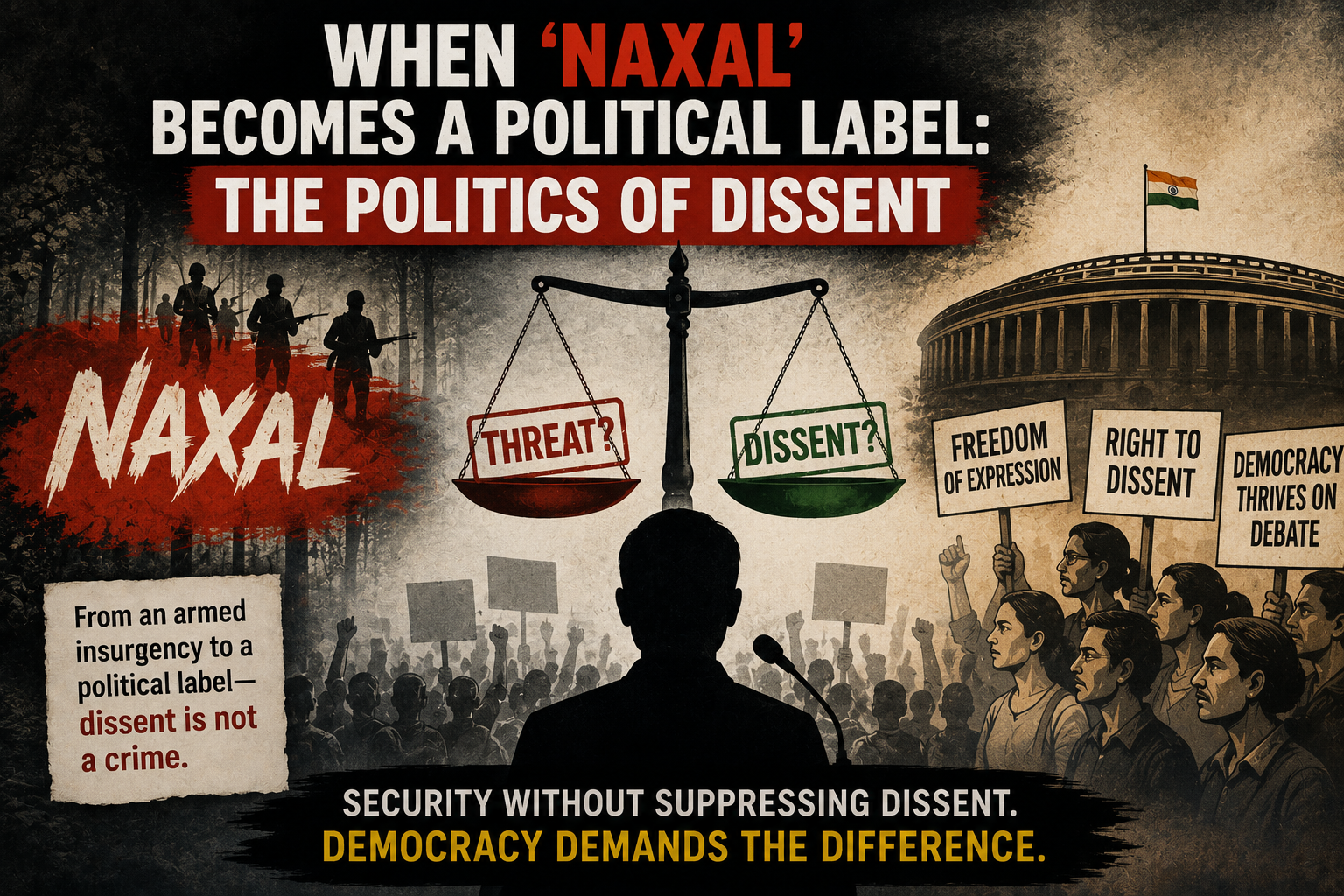
In Indian politics, the scope of meanings attached to a particular word goes far beyond its actual denotation. For instance, “Naxal” was historically used in relation to the Naxalite movement and armed Maoist insurgency but is now often used in political discourse to refer to those people or organizations that are considered radical or anti-establishment. Hence, it gives rise to the problem of how political terminology can affect the public perception of dissenters.
The Naxalite movement emerged in Naxalbari, West Bengal, in 1967 because of the peasant uprising influenced by Marxist-Leninism ideas. In the following years, there appeared several Maoist organizations in different regions of India in places where people were facing poverty, conflicts concerning the land, and lack of access to the institutions of state power. The problem of left-wing extremism is considered a security problem by the government.
However, the use of the word “Naxal” in political discourse has become a problem itself. Many people believe that calling a certain activist, intellectual, journalist, or political opponent “Naxal” without any proof of their participation in the armed struggle mixes up the perception of political dissent with the phenomenon of armed extremism. The moment the term becomes a part of political discourse, it affects the perception of people themselves.
On the contrary, those who support the nomenclature maintain that the government and political factions need to be aware of ideological networks which can serve as an encouragement and justification of violent extremism. This line of thought views the identification of radical ideologies as a means of ensuring national security and social order.
The controversy is rooted in the larger question faced by any democratic society: the need to ensure national security without compromising room for disagreement. Democracy implies critique, debate, and opposition. However, violence and armed insurgency cannot be equated with political disagreement and criticism.
In light of all this, the politics of “Naxal” needs to be carefully analyzed. While labeling makes political processes more understandable, labels without evidence can also widen the gaps even further. An appropriate democratic discussion presupposes the difference between disagreement, ideology, and participation in violent acts.