






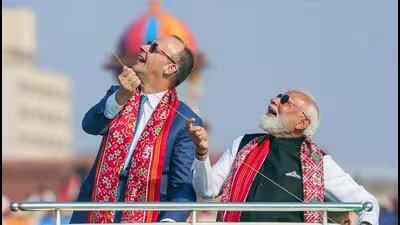
In a significant diplomatic boost for Indo-German relations, Germany has announced a visa-free transit facility for Indian passport holders, aimed at simplifying travel through German airports. The announcement was made during the official visit of German Chancellor Friedrich Merz to India, where he held wide-ranging talks with Prime Minister Narendra Modi — culminating in the signing of 19 bilateral agreements across key sectors including defence, technology, trade and education.
The visa-free transit policy will allow Indian travellers passing through German airports—such as Frankfurt and Munich—to connect to onwards international flights without applying separately for a transit visa, reducing paperwork and facilitating smoother global travel.
What the Visa-Free Transit Means
Under the new arrangement:
- Indian travellers transiting through Germany to third countries no longer need a separate German transit visa, provided they remain in the airport’s international transit zone.
- The measure is expected to cut processing times, reduce travel costs and improve connectivity for Indians travelling to Europe, the US, UK and beyond via Germany.
- Prime Minister Modi personally thanked Chancellor Merz for the initiative, noting that it will strengthen people-to-people ties and support mobility for professionals, tourists, students and business travellers alike
Wide Spectrum of Agreements Signed
The leaders finalised 19 MoUs and joint statements on various strategic sectors that reflect the emerging partnership between India and Germany in:
Strategic Cooperation
- Defence industry cooperation: Co-development and co-production schemes
- Increased military-to-military activities and exchange programs
- Consultation mechanism for Indo-Pacific cooperation
Economic and Technological Collaboration
- Joint commitments on semiconductor ecosystem partnership
Cooperation in critical minerals and emerging technologies
- Agreements to enhance trade, investment, and supply chain resilience
- Agreement/Product Description
Education and Human Capital
- Roadmaps regarding cooperation in higher education, skill exchange, and research collaborations
- Encouragement of academic exchange and institutional representation in both countries
- Mobility facilitation for professionals and students
Green & Sustainable Development
- Pledges for Clean Energy, Green Hydrogen, and Renewable Technology Schemes
- Cooperation in urban infrastructure and climate resilience partnerships
- These developments represent enhanced economic, security, educational, as well as people-to-people ties, thus opening a new chapter for Indo-German relations
Why This Matters
The visa-free transit arrangement and robust suite of agreements signal a deepening strategic partnership between India and Germany — two major democracies with growing economic, technological and geopolitical influence. Analysts say the moves will:
- Enhance connectivity for Indian travellers and professionals
- Boost tourism and mobility between Europe and South Asia
- Expand trade, defence and technology collaboration
- Foster educational exchange and research cooperation between institutions in both countries
The discussions also touched on global issues, including support for a free and open Indo-Pacific region, cooperation on climate action, and collaborative responses to global security challenges.
Conclusion: A Milestone in India–Germany Relations
The visa-free transit facility for Indian travellers announced during German Chancellor Merz’s visit is more than a travel convenience — it represents a symbolic and practical expansion of bilateral cooperation between India and Germany. Paired with 19 strategic agreements spanning defence, technology, trade, education and renewable energy, the outcomes of the meeting underscore both nations’ commitment to a strong, multifaceted partnership.
This enhanced relationship not only simplifies travel logistics for Indian passport holders but also sets a foundation for deeper economic, academic and cultural engagement. As global geopolitics evolve, the strengthening of Indo-German ties — backed by tangible agreements and eased mobility — positions both countries to collaborate more effectively on shared priorities and future opportunities.





More Stories
Rohit Sharma Receives Padma Shri, adds another Milestone to his Illustrious Cricket Career
Abhimanyu Singh: A Young Leader Blending Enterprise, Education, and Social Responsibility for Nation Building
From Memes to Movement: The Viral Growth of Cockroach Janta Party