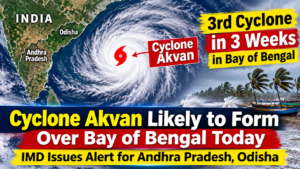



The Bay of Bengal has entered a new phase of weather turmoil as the third big cyclone to hit the zone within three weeks – Cyclone Akvan – is currently gathering strength in the area. The new cyclone is also forming up in the Bay of Bengal and has shifted the focus to the coastal areas of Andhra Pradesh.
As per the India Meteorological Department (IMD), the deep depression over the Bay of Bengal is likely to intensify into a cyclonic storm “Akvan” and is likely to intensify into a Cyclonic Storm when it moves northwestward during subsequent 24 hours. It is likely to cause heavy rains, thunderstorm, strong wind and rough sea conditions over the eastern coastal region of the country.
Due to proper atmospheric and oceanic conditions. The Bay of Bengal has traditionally been more prone to cyclones in the post-monsoon months of October and November. Conditions such as warm sea surface temperatures, elevated humidity and conducive winds give the tropical disturbances the potential to develop into cyclones.
The Akvan has formed following Cyclone Arnab and Cyclone Murasu which have formed over a relatively short period of time. It is not unheard of for different weather systems to form close to each other if conditions are suitable for their formation.
Authorities are still keeping a close eye out for Akvan, who could still pose a danger, especially in Andhra Pradesh’s coastal districts. Fishermen have been told not to go out to sea, and people living in high-risk coastal regions have been urged to heed the weather forecast.
Officials say the IMD will continue to provide further updates on the intensity of the cyclone, as well as forecast its track and rainfall. Local administrations are also keeping an eye on the readiness aspect to reduce any inconvenience.
Since the weather system is evolving, its time we stick to only the official bulletin and refrain from passing around and sharing unconfirmed information. It remains to be seen in the days to come, whether Akvan is headed directly towards Andhra Pradesh or takes a turn over the Bay of Bengal.