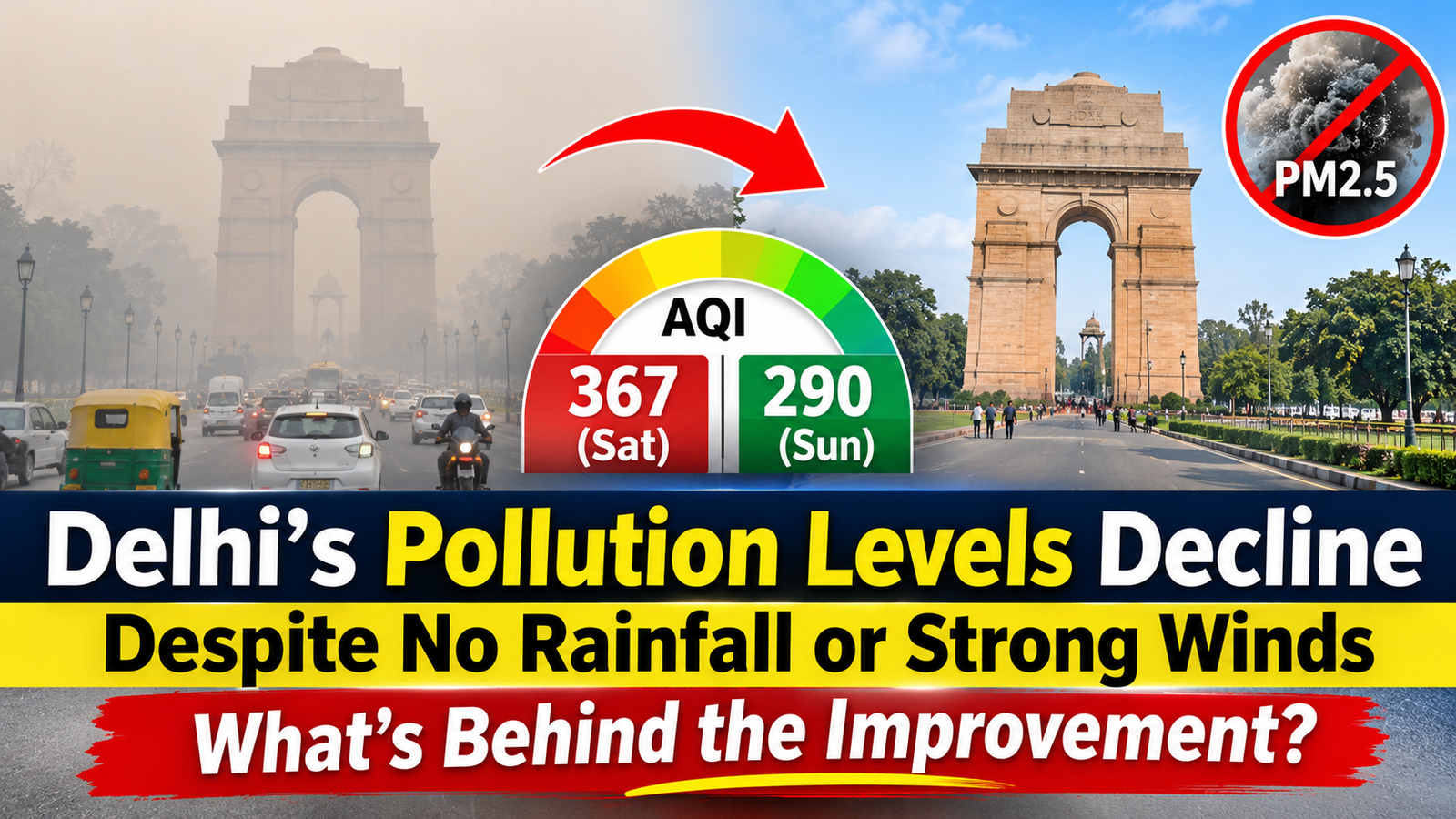
Delhi showed signs of improvement on Sunday, November 15, with levels of pollution falling significantly even though there was no substantial rainfall or high speed wind. PM 2.5 levels significantly decreased at many stations in Delhi.
Based on monitoring data, PM2.5 concentrations at several locations dipped to within the ‘good’ and ‘satisfactory’ categories by 6 pm. Between 2 pm and 3 pm, the concentrations at RK Puram and Major Dhyan Chand Stadium decreased to below 10 micrograms per cubic metre. Nonetheless, the air quality index as a whole remained on the higher side as the index takes into account a 24-hour average.
The diffusion of the patch from the atmosphere, advection of fresh air and transporting cleaner air masses could have contributed to the sudden clearance. No rainfall was recorded at the IMD’s observation stations from 8.30 am to 5.30 pm, but maximum wind speed was recorded as around 15 kmph in the evening hours which could have helped blow away the smog.The AQI was also steady throughout the day. The 24-hour average AQI in Delhi was 290 on Sunday compared to 367 on Saturday, according to data from the Central Pollution Control Board (CPCB). However, some areas still recorded unhealthy air quality.
Biomass burning was still the main contributor to the pollution load. Indian Institute of Tropical Meteorology (IITM) has estimated it to be around 37%, organic aerosols (by-products of chemicals released during burning) about 22% and vehicles emissions about 17% of the Delhi pollution.
But the experts have warned that just because a particulate matter has dropped does not mean pollution has gone forever. Pollution can either be blown away or moved elsewhere.
However, this shift may not even last long as the city may revert to the ‘very poor’ bracket in the next few days as weather forecasts indicate weakening of decadal-winds. The only way to improve Delhi’s air quality is to cut down emissions from vehicular and industrial emissions, construction activities and waste burning.



Delhi’s Pollution Levels Decline Despite No Rainfall or Strong Winds: What’s Behind the Improvement?
Delhi showed signs of improvement on Sunday, November 15, with levels of pollution falling significantly even though there was no substantial rainfall or high speed wind. PM 2.5 levels significantly decreased at many stations in Delhi.Based on monitoring data, PM2.5 concentrations at several locations dipped to within the ‘good’ and ‘satisfactory’ categories by 6 pm.…

by
No comments on Delhi’s Pollution Levels Decline Despite No Rainfall or Strong Winds: What’s Behind the Improvement?
2 minutes
Read Time
About the Author

Previous Post
Next Post
Leave a Reply
Latest News





About the Author

thefirstcritic
The First Critic delivers the latest news and sharp insights across India, politics, business, entertainment, sports, technology, and more.
Search the Archives
Access over the years of investigative journalism and breaking reports