






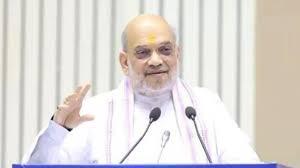
Union Home Minister Amit Shah has announced that India will be totally free from Naxalism before the next national conference of police chiefs.
Addressing the 60th All-India Conference of Directors General and Inspectors General of Police (DGP/IGP) in Raipur, Shah said that a concerted and multi-pronged effort in the last few years has weakened the left-wing extremism considerably.
What has changed: From 126 Districts to Just 11
- During the past seven years, the government has erected 586 fortified police stations, a major enhancement to the security framework
- Consequently, the Naxal-affected districts in the country have reduced from 126 in 2014 to just 11 today.
- This, Shah said, reflects a decisive shift: “The country will be completely free from the menace of Naxalism.”
Strategy: Security + Rehabilitation + Development
Three pillars on which the government’s approach to eliminate Naxalism rests are:
- Security operations – aggressive action against those resorting to violence and dismantling extremist networks.
- Rehabilitation and surrender policy: Encouragement to cadres to surrender, giving them an opportunity to reintegrate peacefully.
- Development in the affected areas: improving infrastructure, ensuring basic amenities, and providing communities with an alternative to extremism.
As Shah said earlier, “Those who choose violence will be dealt with, but those who surrender will be given an opportunity to join the mainstream.”
Target date for elimination: before next police chiefs’ meet
Shah’s recent statements set a firm target: before the next DGP/IGP conference, Naxalism should be wiped out from the country.
Earlier, the official statements had mentioned the date of March 31, 2026 to complete the eradication of Naxalism across India.
What This Means for Security and Governance
- That would be a big turning point as far as India’s internal security goes: it would reduce insurgency drastically, free up resources, and actually allow for development in hitherto conflict-ridden zones.
- Districts under the influence of Naxals could see infrastructure improvement, better law enforcement presence, and increased investment.
- It may also deter extremist recruitment with its reaffirmed “zero tolerance” stance, while offering rehabilitative incentives to those willing to surrender.
Challenges Ahead — And What to Watch
- While a district-by-district reduction is significant, uprooting extremist ideology and support networks is complex.
- Historically, socio-economic grievances and lack of development have fuelled Naxalism, so addressing the root causes will have to be sustained post-conflict.
- Rehabilitation and mainstreaming efforts will be crucial to success; security operations alone may not be sufficient to provide long-term peace.
India’s fight against Naxalism has reached a decisive turning point. With stronger security, fewer affected districts, and continuous development in vulnerable areas, the country is closer to ridding itself of left-wing extremism than ever before. If the trend continues, India will be well on its way toward being completely Naxal-free in the very near future.






More Stories
‘Work shouldn’t consume every hour’: Indian tech professional on UK vs India office culture
NSE is said to invite banks to pitch for nearly Rs 23,000 crore IPO
India’s medium-term macro fundamentals remain healthy, robust: RBI Governor Sanjay Malhotra