

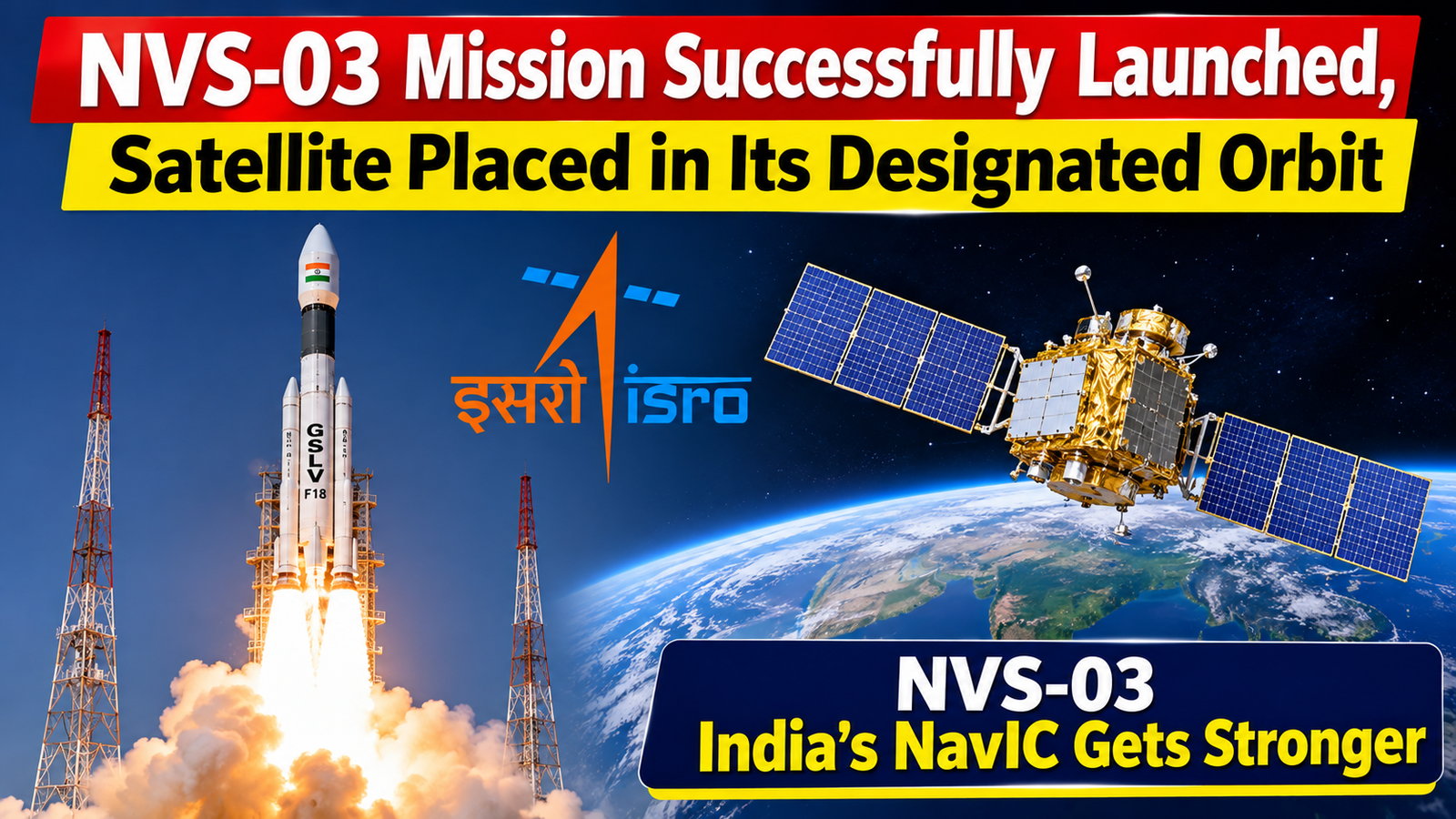
India hits another space milestone with the successful launch of NVS-03 satellite. India has had another achievement in its space programme as the NVS-03 satellite was launched successfully and placed in its intended orbit. This is yet another step by India to strengthen its navigation network and have more reliable satellite-based positioning services.
About the NVS-03 Satellite The Indian Navigation with Indian Constellation (NavIC) system, an autonomous satellite navigation system developed by ISRO. It is a regional system that covers India and the surrounding region. The system is used for time and position information services for a variety of applications including terrestrial, maritime and aircraft navigation, as well as disaster management.
It has a launch weight of roughly 2,232 kg and carries indigenous and commercially obtained atomic clocks. Using the three-month timeline to be used on future space-based navigation satellites, the existing L5 and S-band signals received by the NavIC satellite have L1 frequency signal added as a key technological feature. This would improve its interoperability with other systems worldwide and open up the NavIC’s civilian applications.
The GSLV-F18 rocket was launched from the Second Launch Pad at the Satish Dhawan Space Centre in Sriharikota, Andhra Pradesh, on October 30, at 11:51 pm. The satellite was successfully deployed into its intended Geosynchronous Transfer Orbit (GTO) after an 18-minute flight. Then it will use its own propulsion system to reach its intended final operational orbit.
This successful mission is also very important for India, as it would bring forward nation’s efforts towards self-reliant navigation and reduce the dependence on foreign satellite navigation system. It will be used for real-time train, car, ship tracking and strategic and security applications.
This landmark achievement marks another important milestone for ISRO in the continued goal of enhancing the availability and reliability of NavIC services, further strengthening India’s strengths in space technology.