


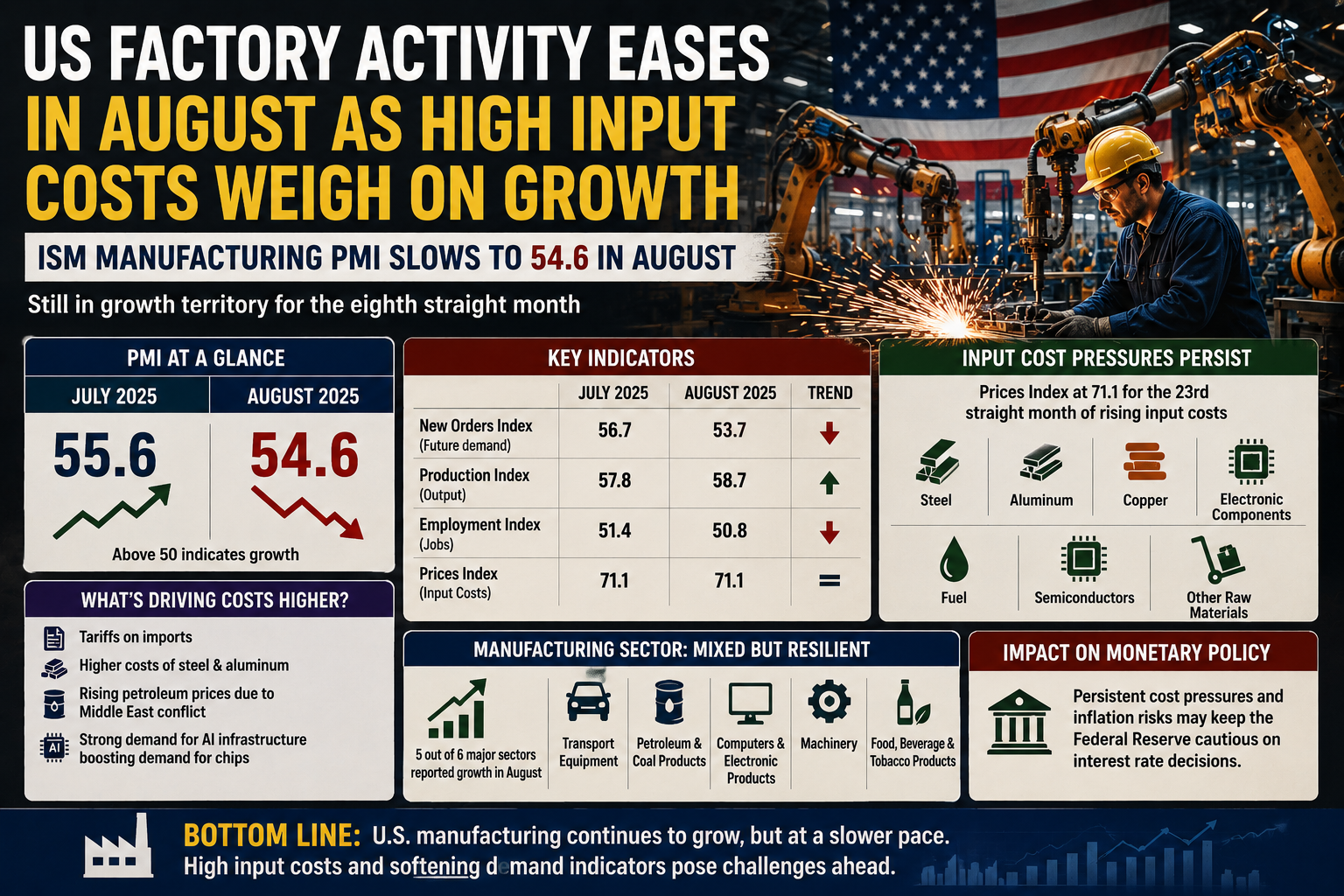
August witnessed continued increase in US manufacturing activities, though at a slower pace compared to the previous month because of weak orders and increasing cost pressure on the sector. The ISM Manufacturing Purchasing Manager’s Index (PMI) indicated that the growth in US manufacturing activities slowed down to 54.6 in August from 55.6 in July, and that number above 50 indicates growth.
For the eighth consecutive month, US manufacturing activities have increased in August. Nevertheless, the slowdown is an indication that the manufacturing firms are increasingly being affected by rising costs of raw materials, supply chain issues, and uncertainties regarding the global economic and trading environment.
The new orders index, one of the indices for future factory demands, declined to 53.7 in August from 56.7 in July, though it remained at its highest level for eight consecutive months. The production activities expanded further, but the employment activities decreased marginally in August compared to July.
Additionally, manufacturers have been having issues concerning the cost of their inputs. The ISM Prices Index stood at 71.1 in August, the same as it had been in July, implying an increase in input prices for the 23rd consecutive month. Higher costs of inputs have been reported in relation to materials like steel, aluminum, copper, electronic components, fuel, and semiconductors.
Tariffs and geopolitical factors have also played a role in the issue. According to the ISM, the increased cost of steel and aluminum, tariffs on imports, and the increased cost of petroleum-based products because of the Middle East conflict have contributed to the increasing cost of inputs. Increasing demand for the development of artificial intelligence infrastructure has also caused increased cost for certain electronic components and semiconductors.
However, regardless of all these problems, the manufacturing sector appears to be thriving. Out of the six biggest sectors in manufacturing monitored by the ISM, five sectors saw growth in August. They include production of transport equipment, petroleum and coal products, computers and electronic products, machinery, and food, beverage, and tobacco products.
Moreover, the ongoing combination of expansion in factories alongside pressures on prices might also have an impact on U.S. monetary policy decisions. Inflation dangers might become another reason for the assumption that the Federal Reserve might be rather careful when considering interest rates due to fears about spreading cost hikes.
In conclusion, it should be noted that, according to the data available in August, the U.S. manufacturing industry continues to expand but at a decreasing rate. With input prices remaining high and demand indicators slowing down, difficulties may come for manufacturers in the near future.