

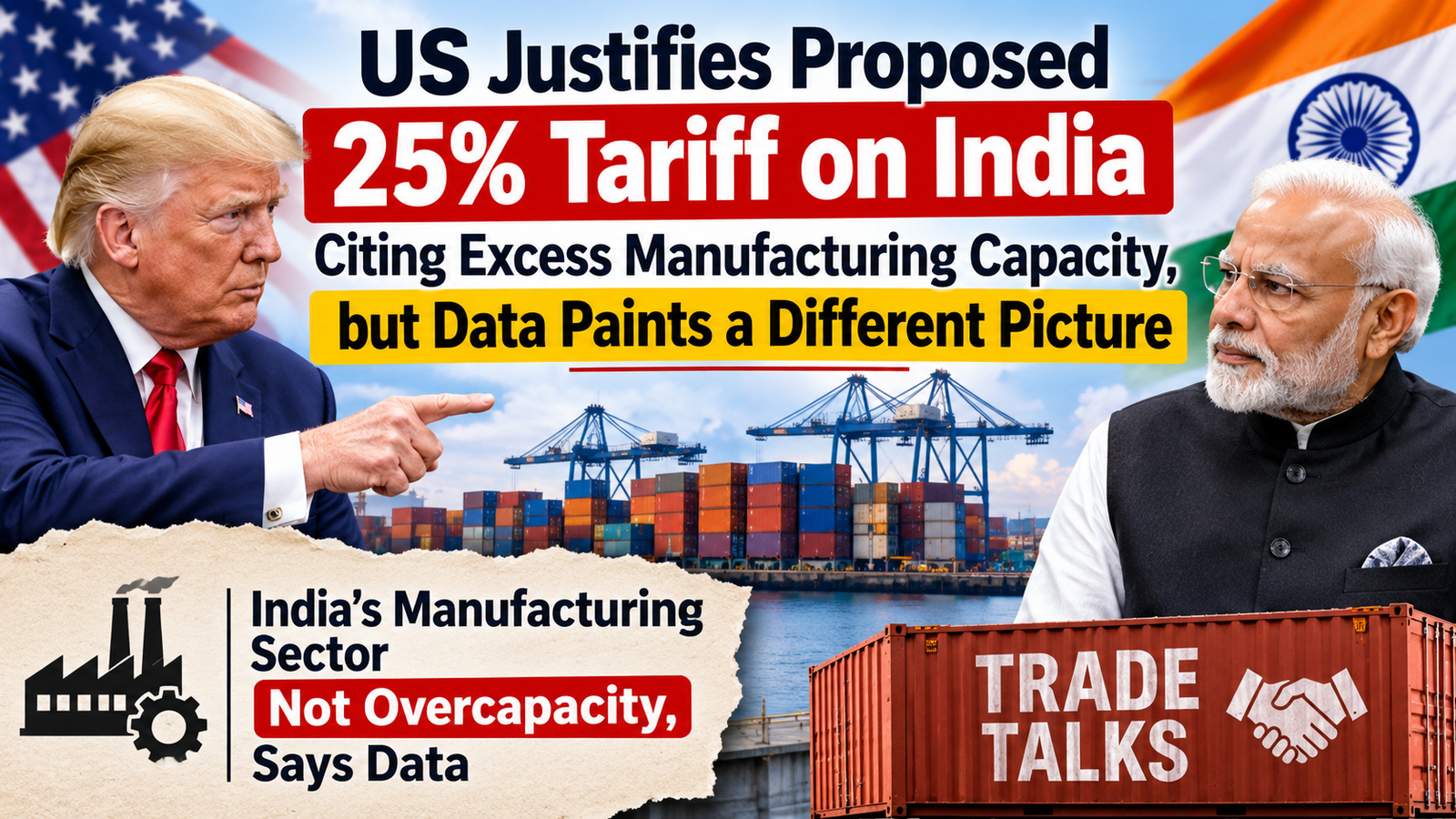
Alleging overcapacity in India as the reason behind the intention to impose a 25 percent tariff has once again sparked rumours regarding India – United States trade relations. The claim is however contradicted by data on India’s manufacturing sector.
Domestic manufacturing is fostered through a whole range of schemes, from Make in India to a variety of production linked incentive (PLI) schemes intended to attract manufacturing investment, secure supply chains, raise exports and achieve import substitution. However, India’s manufacturing sector still wrestles with issues pertaining to its infrastructure, level of technology, the cost of logistics, and its capacity to contend on the global stage.
India argued that its manufacturing capacity build-up aims to fulfil rising domestic demand and improve its standing in global supply chains, not to generate overcapacity. New Delhi also contested Washington’s claims in the probe, asserting that India does not have structural overcapacity in any manufacturing sector.
USTR announced the findings of the overcapacity and subsidy investigation on 25 November, conducted under Section 301 of the Trade Act of 1974 and covering 16 economies including India, China, Japan, and the EU. Issues cited include industrial policies, labour protections, finance and market access restrictions as well as specific sectors, such as pharmaceuticals, medical devices, steel, solar, and ICT.
But the duty proposal is subject to further procedures, including a comment period and hearings scheduled for January 2027. The US has proposed to impose duties of up to 25% on Indian goods while stating it would bring the rate down to 17% if it concludes a trade deal addressing its issues with India.
The timing of the move is delicate as India and the US are in the process of negotiating a broader trade pact, and the US is a top destination for Indian exports, thereby making adjustments in tariffs a matter of importance for Indian producers and exporters.
India’s reaction to and economic inputs from consultation proceedings could be useful to influence the final stance on the matter. This in turn brings us back to the conundrum of harmonizing industrial policy with trade and competitiveness in the market, an issue central to the craft of trade policy.