




Government-Led Economic and Employment Growth
The menstrual health industry is becoming increasingly acknowledged as an important factor
in economic development, job creation, and positive health outcomes, thus encouraging the
governments in the world to increase their investment in this industry. While menstrual health
was once viewed simply as a matter of health and social policy, it has now become a critical
area in terms of economic growth and empowerment of women through innovation. The
governments have been taking various policies and other measures to develop the
menstrual health landscape, making it more accessible in terms of menstrual hygiene
products, and creating job opportunities.
This increased attention towards the menstrual health industry occurs against the backdrop
of increased realization of the costs involved due to lack of proper management of menstrual
hygiene. Millions of women and girls around the world are unable to gain easy access to
affordable menstrual products, lacking sufficient knowledge about menstrual hygiene, and
proper sanitation facilities that can help improve their productivity levels, both academically
and professionally.
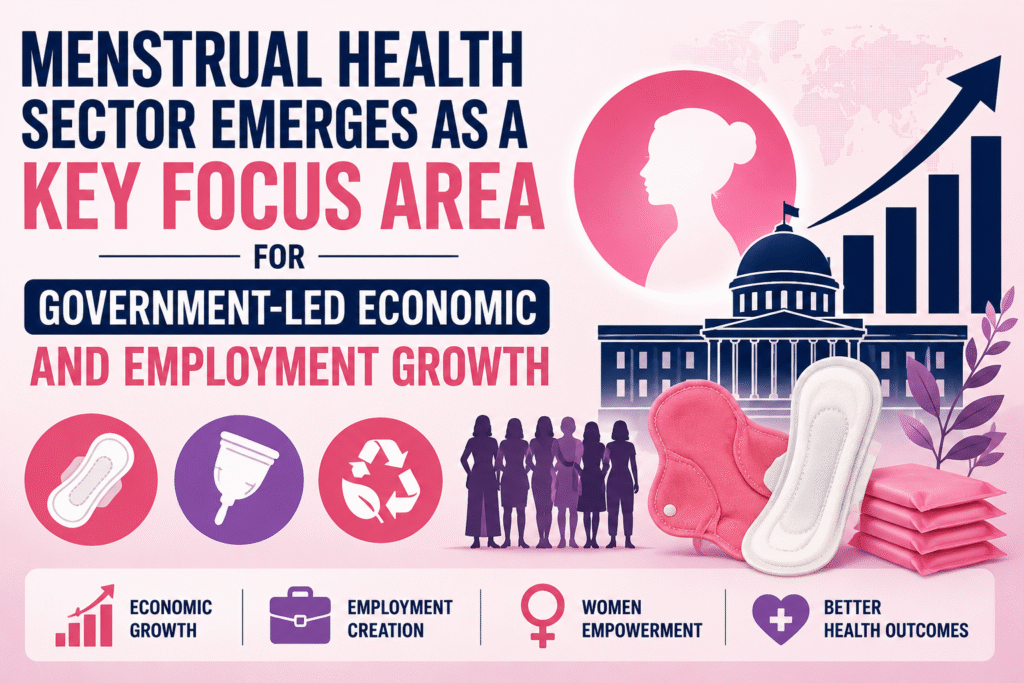
The menstrual health business also holds significant possibilities in terms of providing jobs, especially
to women entrepreneurs and employees. There is potential for job creation at various levels in this
field, whether in the manufacture of sanitary napkins and reusable menstruation products, developing
distribution networks, or undertaking awareness campaigns. Small and medium enterprises, as well as
self-help groups, are increasingly becoming stakeholders in the menstrual health ecosystem, creating
local economic development through addressing critical public health issues.
Moreover, there are technological and sustainability innovations taking place in the field. Innovations
include the production of biodegradable sanitary products, menstrual cups, and innovations that
monitor health. These innovations create new markets as well as attract investments from private and
public sectors. Governments see these innovations as ways of promoting entrepreneurship and
fostering domestic production among other economic developments.
Strategically investing in menstrual health is anticipated to yield great social and economic gains
through better learning results, female labor force engagement, healthcare cost savings, and
sustainable job creation. With governments focusing on developing inclusive economies and gender
equality, the importance of the menstrual health industry in formulating economic policies and
promoting economic growth will only increase in the future. The emerging understanding of
menstrual health as a public health requirement as well as an economic resource represents a major
breakthrough in how societies view women’s health and development.




More Stories
MOH Cautions TPAs Against Intervening in Clinical Practice, Citing Potential
The Semiconductor Surge Is Transforming Student Preferences in
Oxford’s New Educational Hub Underscores the Growing Role of