






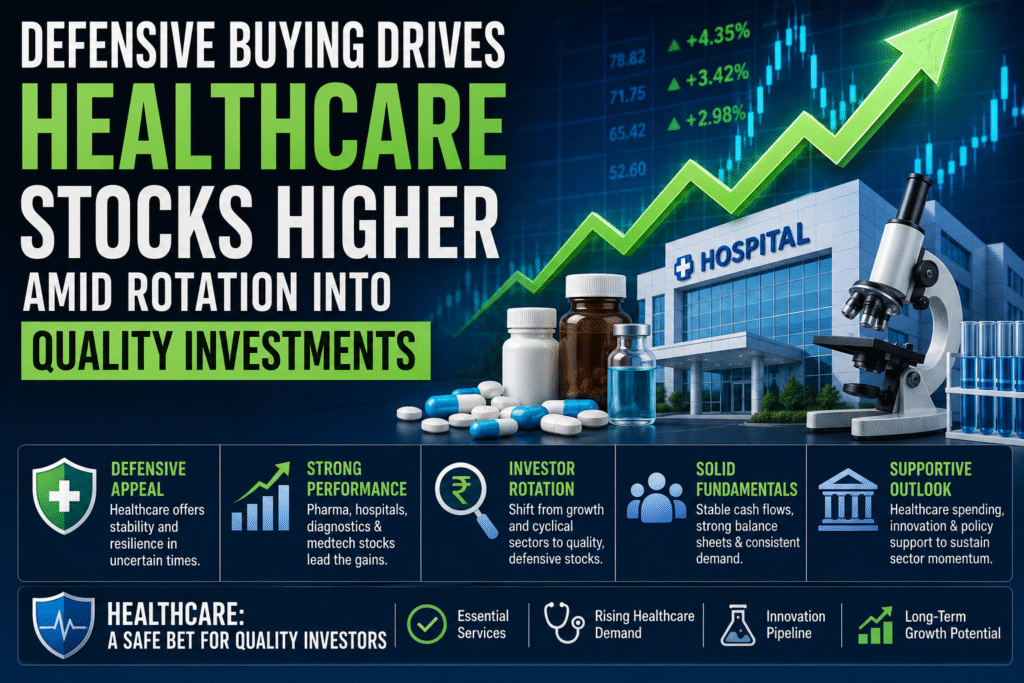
Into Quality Investments
The healthcare industry stands out as a top-performing industry in the most recent market
sessions owing to the increasing inclination of investors to move their investment portfolios
to defensive and quality stocks in the face of rising market uncertainties. This is indicative of
the general tendency among both institutional and retail investors for defensive and reliable
stocks in times of economic volatility and unpredictable market sentiments.
The defensive nature of the healthcare industry has seen many investors turning to it owing
to the prevailing uncertainties about the economic situation in the global financial system. It
has been observed that industries with stable cash flows and solid balance sheets have
found favor with investors who want to preserve their capital but also invest in equity
markets.
Outstanding performance of healthcare companies has been attributed to high levels of
confidence exhibited by investors in companies within this sector such as pharmaceutical
companies, hospitals, diagnostic companies, medical devices companies, and healthcare
technology companies. Companies in this sector are typically resilient against economic
slumps because of the essentiality of healthcare and stable consumer demand regardless of
economic conditions.
Strategists in the market have noted that there is a change of investing environment
whereby investors have moved away from growth stocks and cyclical sectors to invest in
businesses that have stable business models and solid financials. Investing in healthcare
stocks has become attractive because of the characteristics of stability and growth
opportunities in the company.
There were various top healthcare stocks which saw huge increases in their stock prices
after an increase in investments into sectors that are not adversely affected by economic
slowdowns. The success of pharmaceutical companies was particularly because of expected
earnings, innovations in drugs, and expansion in healthcare spending.
Healthcare institutions were also under the spotlight due to their improved performance,
increase in patient traffic, and investments in healthcare infrastructure. The stability of cash
flows from this industry during volatile markets makes it more popular as a defensive
industry.
In addition to that, the recent revival of interest towards health care stocks is also linked to
the fact that market analysts expect the government to maintain expenditures on healthcare
infrastructure, continue insurance coverage, and make additional investments in medical
innovations.
Finally, global tendencies have had an impact on the performance of this industry. Investors
from around the world tend to prefer defensive industries due to uncertainties regarding
interest rates, inflation, and geopolitics. The healthcare sector, along with utilities and
consumer staples, demonstrates relatively good results during uncertain economic times due
to its non-discretionary features.Analysts opine that the healthcare industry may continue to show superior performance, in
case volatility in the market continues and there is a preference by investors for quality and
defensive stocks. However, at the same time, it needs to be highlighted that stock selection
is very important, since valuations in some areas of the healthcare industry have increased
significantly after market gains.
Going forward, it is anticipated that market participants will watch earnings, regulation,
healthcare expenditures, and economic indicators to analyze the sustainability of the
momentum in the healthcare industry. Even though short-term volatility might continue in the
short run, the defensive nature of the healthcare industry along with a very positive
fundamentals story makes it one of the most important industries from an investment
perspective.
With volatile times on account of uncertain economic environment across the globe, the
recent trend of rotating into quality healthcare stocks demonstrates the significance of
defensive investing in this sector.






More Stories
Five-Year US-Tanzania Health Partnership Secures $1.3 Billion
MOH Cautions TPAs Against Intervening in Clinical Practice, Citing Potential
Menstrual Health Sector Emerges as a Key Focus Area for