





Investment
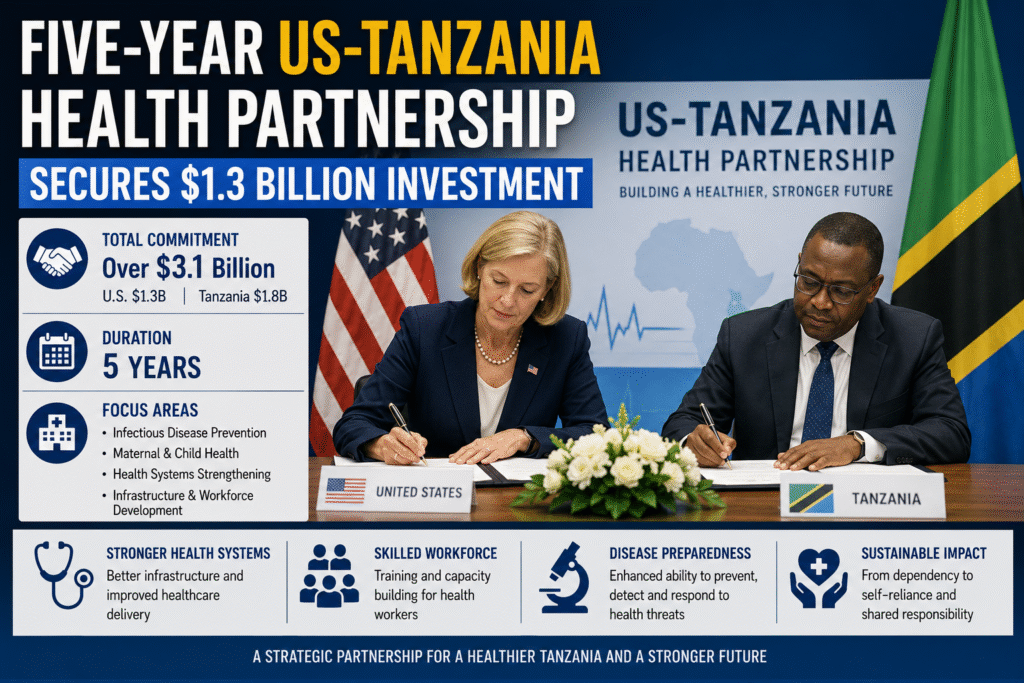
The U.S and Tanzania governments have inked an unprecedented five-year agreement
worth over $1.3 billion in order to develop the healthcare infrastructure of the latter nation.
This deal represents a great stride towards not only improving the public health infrastructure
of Tanzania but also increasing the sustainability of this nation’s healthcare delivery systems.
The MoU was signed in the Tanzanian capital city and falls under the America First Global
Health Strategy of the U.S aimed at transforming how global health assistance is provided to
partner countries in a manner where they take over the responsibility of managing and
funding their health systems in a phased manner. Besides the US pledge of over $1.3 billion,
Tanzania also commits $1.8 billion towards improving the health sector of the nation in the
span of the next five years bringing the total value of this collaboration deal above $3.1
billion.
As stated by the respective countries’ officials, this arrangement is geared towards helping
the Tanzanian government prevent, detect and respond to infectious diseases as well as
improve healthcare service delivery.
Joint investment by both partners in the agreement represents their commitment towards
addressing key public health issues such as HIV/AIDS, tuberculosis, malaria, polio, and new
diseases. The joint effort will also address the issue of maternal and child health care,
construction of additional medical facilities, as well as the development of skills of health
workers in Tanzania.
According to the Tanzanian minister of health, Mohamed Mchengerwa, who spoke during the
signing ceremony, the partnership is aimed at building an independent and sustainable
healthcare system. In other words, the partnership marks the shift from the model of
dependency towards the model of mutual responsibility, accountability, and sovereignty.
“This is not an agreement about maintaining the dependency but about developing a
strategy for self-sufficiency,
” Tanzanian authorities said.
The United States has also used the agreement as one step towards ensuring sustainable
health care partnerships in Africa. Other such agreements have already been reached with
countries such as Kenya, Rwanda and Uganda, signaling a change in the approach of U.S.
health aid in Africa by focusing on bilateral partnerships that place more emphasis on local
ownership and sustainability.
In contrast, the overall health policy strategy has raised controversy in some African nations
because of fears that relate to matters such as natural resource exploitation, data
management in health and biological specimen sharing.
Tanzanian officials have sought to allay such fears by asserting that the recently signed
agreement does not contain any clauses relating to biological specimen sharing with the
United States.Minister Mchengerwa reiterated Tanzania’s right to her health data and biological specimens,
noting that all lab specimens will be retained in Tanzania irrespective of whether they relate
to disease outbreaks or pandemics.
.
According to health practitioners, when this partnership works well, it can be of great benefit
to the country, in terms of reinforcing its healthcare system, preparedness for any disease
outbreak, and minimizing its dependence on aid from other countries in the long run. A lot of
funding is going to be used for the establishment of hospitals, laboratories, and training of
healthcare workers.
As global health threats change, this US-Tanzania partnership stands out as an excellent
illustration of international collaboration in terms of creating sustainable and resilient
healthcare systems. In addition, the success of the agreement can affect how future global
health collaborations will be designed, especially by developing nations.






More Stories
Japan’s Services Sector Sees Uptick in June Amid Inflationary
Defensive Buying Drives Healthcare Stocks Higher Amid Rotation
MOH Cautions TPAs Against Intervening in Clinical Practice, Citing Potential