






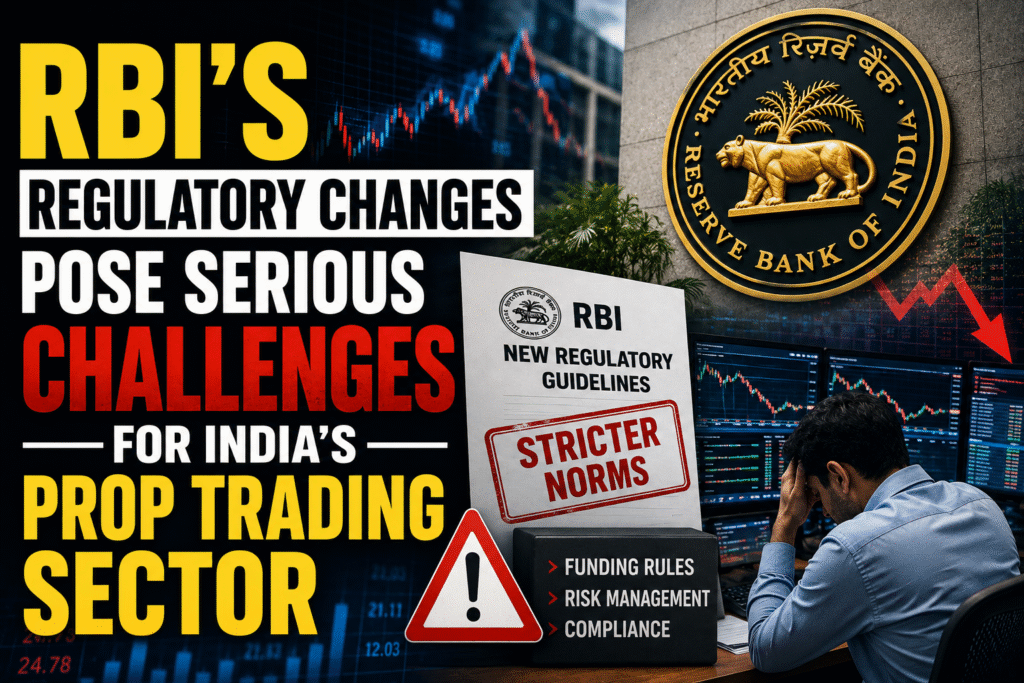
Trading Sector
The recent regulatory measures adopted by Reserve Bank of India (RBI) in relation to
funding methods have raised considerable apprehensions among India’s proprietary (prop)
trading community. Participants in the market are under the impression that the new system
would cause considerable modifications in the operating environment for prop traders,
resulting in changes in strategy for many companies.
Prop trading companies are better known as prop firms, and they basically offer money to
the traders in return for a part of the profit earned through trading. In the last few years, there
has been a considerable growth in this sector in India, with many new traders entering the
market without investing too much of their own money.
However, the RBI’s recent initiatives with respect to regulating financial regulations and
improving the regulation of funding channels have added an element of uncertainty to the
industry. As per market analysts, stringent norms with regard to funding, risk management,
and financial transactions may result in higher compliance costs and reduce the ability of
proprietary traders to be flexible.
The industry players feel that such initiatives may have a significant impact on the business
models of many proprietary trading companies that function based on funding structures and
partnerships. The smaller proprietary trading firms would find it difficult to cope up with the
new regulations owing to their financial and operational constraints. In fact, some have
called the move a big blow to the growth prospects of the industry.
Advocates of the RBI’s move, on the other hand, feel that it is essential to have more
regulations to ensure transparency and minimize risk exposure along with safeguarding the
interests of retail investors who might be prone to financial risks due to lack of regulation.
The changing regulatory environment will be likely to force companies to improve their
compliance procedures, seek multiple sources of funding, and take risk management
measures into account. Although this change will pose short-term challenges, the
adaptability of the sector will decide its future prospects.
As India’s financial markets keep growing and attracting new players, the relationship
between innovation, access to the markets, and regulation becomes an important factor that
needs to be taken into account. The next few months will prove whether India’s proprietary
traders will cope with these challenges.As India’s financial markets keep growing and
attracting new players, the relationship between innovation, access to the markets, and
regulation becomes an important factor that needs to be taken into account. The next few
months will prove whether India’s proprietary traders will cope with these challenges.





More Stories
IRDAI Clears Two Global Investors for Substantial Stakes in Indian Insurance
Indian State Government Finances: Balancing Budgets on a Fiscal
Today’s Gold and Silver Prices, June 29: Retail Rates for 24K, 22K