





As a way of ensuring infrastructure safety in India, the Indian Institute of Technology Madras
together with C-DAC (Centre for Development of Advanced Computing) will work together to
control an advanced software system aimed at monitoring bridge health. Through this
partnership, efforts have been made to ensure that the latest digital technology is used to
enhance the safety and lifespan of bridges in the country.
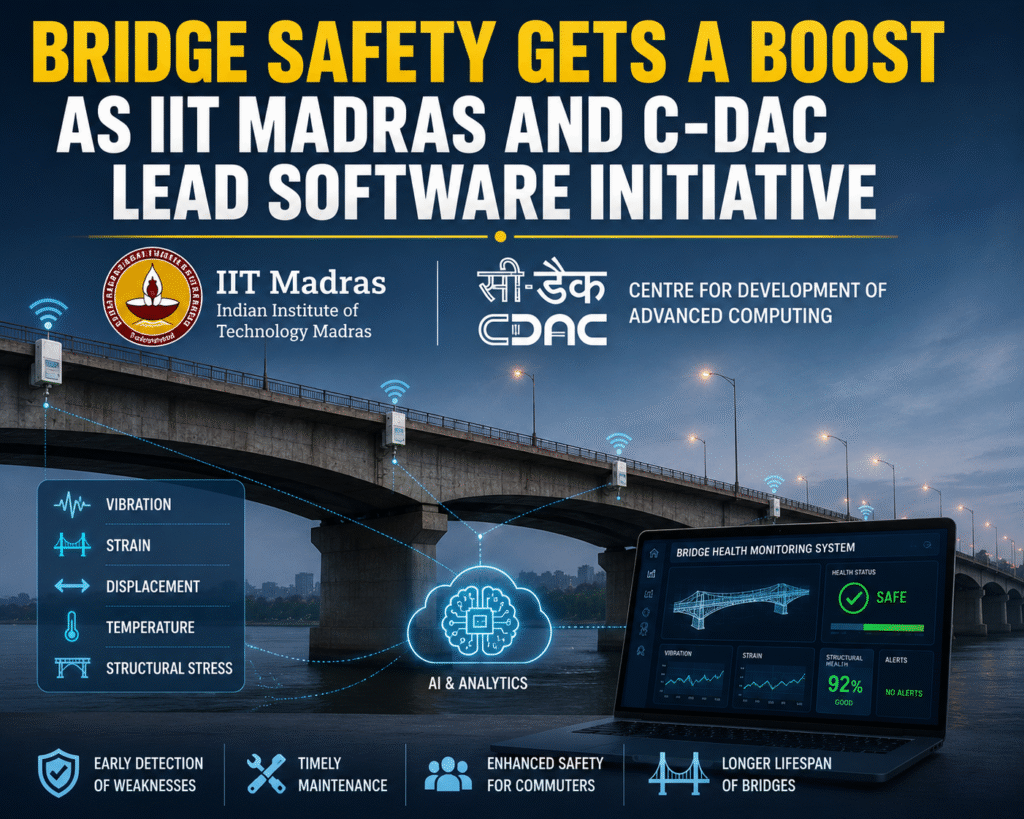
The software system is expected to continuously monitor bridges structurally based on
information obtained from sensors fitted in vital parts of the structure. Information gathered
through the sensors includes things like vibration, strain, displacement, temperature, and
structural stress.
Analysis of this information through complex algorithms will enable the system to give
information in advance about any structural weakness. This will give the authorities
responsible for maintenance enough time to repair any part that needs fixing.
This collaboration involves two renowned institutions: IIT Madras with its specialization in
research on engineering science and C-DAC, which is India’s leading agency in matters of
high-performance computing and digital technologies. In this partnership, the organizations
strive to create an efficient software platform that will enable bridge monitoring programs
irrespective of geography and climate in the country.
The country has numerous bridges serving as key elements in its infrastructure to provide
road and rail transport facilities. These bridges need regular monitoring as many of them
have been in use for several decades now. Conventional inspections done manually are
important but do not always help detect possible problems in good time. Digital monitoring
will be an effective means of assessing the state of bridges in addition to manual inspection.
In addition, this initiative comes against the background of the government’s efforts to
embrace digital technology and create smart infrastructure in the country. With the help of
the Internet of Things, artificial intelligence and data analytics, decision-making related to the
management of infrastructure assets will become easier.
It is thought that such a move will make the infrastructure more resilient, increase safety for
commuters, and help prolong the life span of bridges. It can even act as a precedent for
monitoring other pieces of infrastructure such as tunnels, flyovers, and highways.
With India’s infrastructure continuing to develop into the future, such collaborations between
top institutions of research and technology will surely play an important part in creating a
better and more sustainable infrastructure in the future.





More Stories
8.18% GDP Growth Boosts Confidence, but Economic Pressures Could Weigh on the
Three-Quarters of New Human Infectious Diseases Have Animal
Prof. Arun Mohan Sherry Appointed as New Director of IIM Shillong