


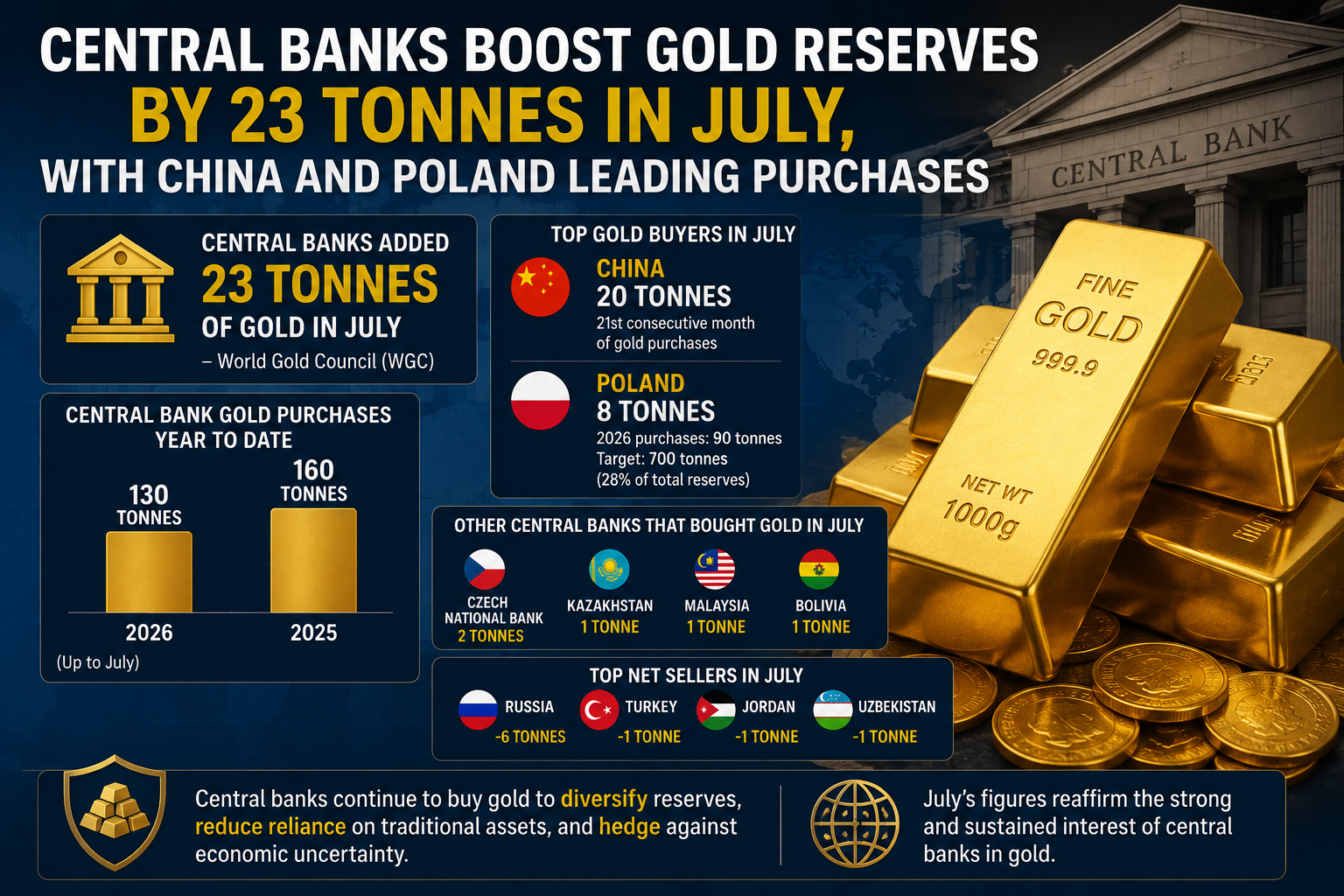
The world central banks kept on increasing their gold reserves in July, buying 23 tonnes of gold overall according to the data published by the World Gold Council (WGC). In July, China and Poland became major buyers of gold.
The central bank of China bought 20 tonnes of gold in July and thereby turned out to be a buyer of gold for the 21st month in a row. To date, the purchase of gold by China led to the increase of its official gold reserves to 2,366 tonnes, which means that gold constitutes 8% of the total reserves. The purchases of gold in 2026 were 60 tonnes.
Also in July, there was another buyer of gold – Poland. This country purchased 8 tonnes of gold in July. Up to date, the total amount of gold reserves in Poland is 640 tonnes, whereas the purchases of gold in 2026 were 90 tonnes. The target set by Poland is to have 700 tonnes of gold, accounting for 28% of the total reserves.
The same was done by other central banks. Czech National Bank bought 2 tonnes of gold, continuing its series of consecutive monthly net buys. In addition, Kazakhstan, Malaysia, and Bolivia each bought 1 tonne of gold.
On the other hand, gold purchase was partially offset by sales from other countries. Russia became the largest net seller, cutting its gold reserves by 6 tonnes. At the same time, Turkey, Jordan, and Uzbekistan each sold 1 tonne of gold. Year to date, world central banks report roughly 130 tonnes of net gold purchases in 2026, versus about 160 tonnes during the same period last year.
Continued purchase is explained by the crucial role that gold plays for central bank reserves management. Diversification from traditional reserve assets and hedging purposes may serve as additional incentives to buy gold.
Therefore, July figures confirm the persistent interest of central banks in gold despite the variable pace of purchases. Given the high buying rate maintained by China and Poland, the official sector remains a significant buyer on the world gold market.